|
| ||||||||||||||||||||||



|
| ||||||||||||||||||||||

The topics addressed in this series of four webinars will act as a bridge to the workshops and discussions that will take place at the DPA’s annual conference, Pathology Visions. Pathology Visions will take place October 28-31, 2012 in Baltimore, Maryland. Aside from preparing for Pathology Visions, the DPA also wants to continue educating and generating awareness for the field of digital pathology. That’s why they’ve partnered with the Association for Pathology Informatics (API) and CAP Today to host the webinar series.
The first webinar in the series will take place this Wednesday, May 9, 2012 from 11 AM to 12 Noon EDT. The main focus of this webinar is “Cultural and Strategic Barriers to the Adoption of Digital Pathology”. President of the DPA, Dirk Soenksen of Aperio, will be a contributing speaker during the webinar, as well as Dr. Sylvia Asa and Dr. Keith Kaplan.
The remaining three webinars will take place at the same time, 11 AM to 12 Noon EST, on the following dates and focus on the following topics:
July 25 | Financial Barriers to the Adoption of Digital Pathology
September 19 | Technical Barriers to the Adoption of Digital Pathology
November 14 | Regulatory Barriers to the Adoption of Digital Pathology
Participation in each of the webinars is free, but advance registration is required. To register now, please click here. If you are unable to tune in live to the webinars they will be archived on the DPA website. However, these archives will only be available to DPA members. To learn more about what benefits a DPA membership offers or to join today please click here.
About the DPA
The Digital Pathology Association, located in Indianapolis, IN, was founded in 2009. 
For more information about the webinar series and how to register for the Digital Pathology Association’s Pathology Visions Conference visit: http://digitalpathologyassociation.org/pathology-visions-conference.


Ventana announces another FDA cleared image analysis application for use with their p53 clone, scanner and software to determine p53 expression levels in breast cancer.
Ventana Medical Systems, Inc. (Ventana), a member of the Roche Group, received 510(k)clearance from the U.S. Food and Drug Administration (FDA) for the VENTANA Companion Algorithm p53 (DO-7) image analysis application using the VENTANA iScan Coreo Au scanner and VIRTUOSO software. Currently, Ventana is the only company offering an FDA-cleared p53 image analysis algorithm for determining p53 expression levels in breast cancer patients. Ventana is offering the p53 (DO-7) image analysis algorithm in addition to the company’s FDA-cleared algorithms for HER2 (4B5), PR (1E2), and Ki-67 (30-9).
“As a market leader and long-term innovator in anatomic pathology, Ventana is committed to improving the lives of cancer patients,” says Mara G. Aspinall, President, Ventana Medical Systems, Inc. “We provide the most clinically-validated, FDA-cleared digital pathology algorithms in the market today. When you combine this with our broad portfolio of instruments and assays, and our expertise in laboratory knowledge management and workflow, it is clear that Ventana is positioned to deliver the most comprehensive digital pathology solutions available globally.”
The p53 (DO-7) image analysis algorithm assists pathologists in the detection and semi-quantitative measurement of p53 (DO-7) protein in formalin-fixed, paraffin-embedded normal and neoplastic tissue. When the p53 (DO-7) algorithm is used in conjunction with the CONFIRM anti-p53 (DO-7) Primary Antibody, it may be used as an aid in the assessment of p53 expression in breast cancer patients (but is not the sole basis for treatment). The FDA clearance includes all of the components of the VENTANA laboratory workflow solution when used as a system, including the company’s BenchMark XT slide stainer, p53 clone DO-7, iView and ultraView DAB detection systems, VENTANA iScan Coreo Au slide scanner, and Virtuoso image management software.
Steve Burnell, PhD, VP, Ventana Digital Pathology and Workflow states, “As is the case for Ki-67, Ventana is the only company offering a 510(k)-cleared algorithm for p53 today. Our increasing Companion Algorithm portfolio of FDA-cleared products is evidence both of our unique capabilities in this field as well as our commitment to empower our customers to deliver the highest standards of patient care through the most robust digital pathology solutions available.”
In conjunction with this clearance, Ventana also received FDA clearance for the digital read application that allows pathologists to interpret p53 (DO-7) stained slides as images on a computer monitor using the iScan Coreo Au scanner with VIRTUOSO software.
About Ventana Medical Systems, Inc.
Ventana Medical Systems, Inc. (“VMSI”) (SIX: RO, ROG; OTCQX: RHHBY), a member of the Roche Group, innovates and manufactures instruments and reagents that automate tissue processing and slide staining for cancer diagnostics. VENTANA solutions are used in clinical histology and drug development research laboratories worldwide. The company’s intuitive, integrated staining, workflow management platforms, and digital pathology solutions optimize laboratory efficiencies to reduce errors, support diagnosis and inform treatment decisions for anatomic pathology professionals. Together with Roche, VMSI is driving Personalized Healthcare through accelerated drug discovery and the development of “companion diagnostics” to identify the patients most likely to respond favorably to specific therapies.
Visit http://www.ventana.com to learn more.
Source: Ventana


“Cancer flashlight” is the nickname some have given to a system that uses novel spectroscopic techniques to detect pre-cancerous cells in the colon. Developed by bioengineers at Duke University, the device may offer an alternative to current biopsy methods for detecting cancer and pre-cancer by anatomic pathologists.
Read more: Duke University Researchers Demonstrate that Non-invasive Optical Biopsy Detects Cancer | Dark Daily http://www.darkdaily.com/duke-university-researchers-demonstrate-that-non-invasive-optical-biopsy-detects-cancer-50712#ixzz1uBpDybhf


Gamers diagnose malaria almost as well as "expert" pathologists using Android or tablet platforms.
Maybe it is time with digital pathology to re-learn some computer gaming techniques and strategies.


I am very excited to announce a wonderful looking new exhibition curated by friend-of-Morbid-Anatomy and Minnesota Rogue Taxidermist Robert Marbury. With the ever increasing popularity of taxidermy in the fine arts world, this "Rogue Taxidermy Biennial Taxidermy Show"comes not a second too soon, and features the work of such creative-taxidermic luminaries as Sarina Brewer (top, "Sweet Dreams"), Adam Wallacavage, Jeanie M. (center, "Arabian Squirrel on a Flying Carpet"), Jessica Joslin, and our own Daisy Tainton (bottom, "A Patient's Despair"), teacher of Saturday's Anthropomorphic Insect Shadowbox workshop (more on that here).
If I was in Los Angeles, I would be on my way to see this right now! For those of you in the area, full info follows:
ROGUE TAXIDERMY
Our Biennial Taxidermy Show
La Luz de Jesus Gallery
May 4th – 27th, 2012The Rogue Taxidermy 2012 Biennial, curated by Robert Marbury, features 25 of the most interesting artists working in taxidermy today. Rogue Taxidermy, a mixed-media art utilizing taxidermy materials, is more closely related to surrealism than to mainstream taxidermy. The work in this show spans genres and materials to expresses the individual artist's approach to and love of natural history and preservation.
There are some great photos from the opening here.
All members of the MINNESOTA ASSOCIATION OF ROGUE TAXIDERMISTS implicitly pledge by merit of their membership to abide by the following ethical regulations:1. All members pledge to continually strive to make efficient use of the animals and parts of animals employed in the creation of their art. Wastefulness is strongly discouraged.
2. Animals shall be procured in a manner that does not require their termination for the explicit purpose of mounting or displaying. Collecting road-kill, accepting, purchasing animals from supply companies and from grocery stores are all considered to be acceptable, ethical means of procuring animals. Recycling and re-use are primary tenets of the association.
3. Please note that it is your responsibility to check with your local Department of Natural Resources and fish & wildlife authorities regarding your taxidermy activities. Be aware that endangered, threatened and protected species (including, but not exclusive to, raptors and songbirds) can only be mounted for museums and educational institutions providing all necessary permits. Roadkill is not excluded from these regulations. Additionally, in accordance with state and federal law, anything utilizing waterfowl, crows, or other restricted birds can only be mounted for the client who provides the animal with all attending permits.
4. If approached to create a custom mount which is generally considered to be a specialty of another M.A.R.T. member, it is strongly suggested that you recommend the services of that member to the potential customer before accepting the commission.
5. Members are greatly encouraged to participate in the care and conservation of living animals.
6. M.A.R.T. seeks to create an open dialogue about the place of animals in our culture. Protests, slander, and admonitions shall be greeted with an attempt to foster conversation. Reacting to criticism in a cruel or indignant way is considered antithetical to the M.A.R.T. mission statement.
You can find out more about this exhibiiton by clicking here. If you are interested in signing up for Daisy Tainton's class, click here for more.

Source:
http://morbidanatomy.blogspot.com/feeds/posts/default?alt=rss
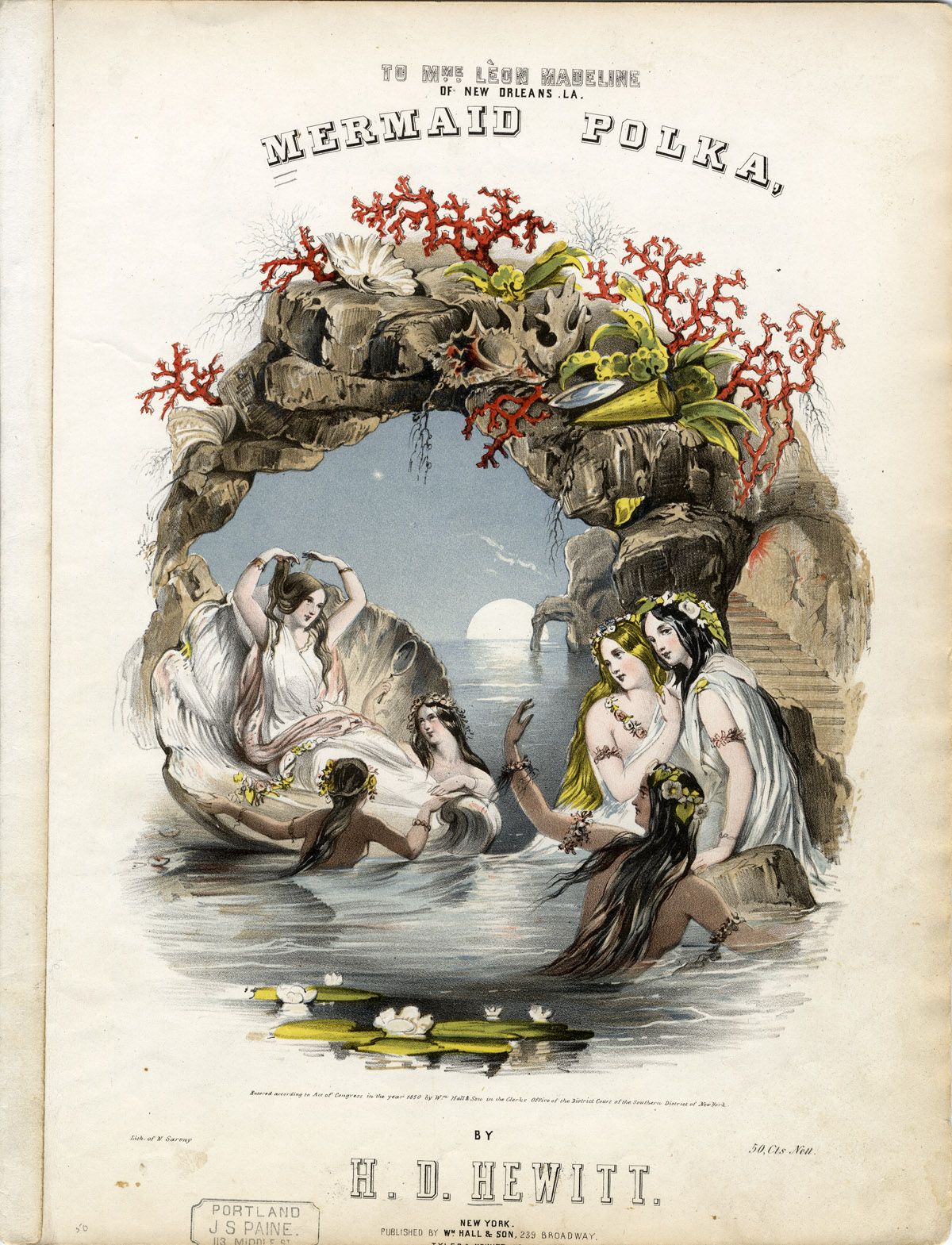
I love these delectable creatures of the nautical sublime, especially their seaweed bracelets and headdresses. As described on the Beauty, Virtue and Vice online exhibit of the American Antiquarian Society website (from which the images is also sourced):
Mermaid Polka. Lith. of Napoleon Sarony, 1850. [H. D. Hewitt]
In the nineteenth century, informal musical entertainments were a very common American pastime, and the piano was a common presence in American parlors. The piano’s rise in popularity coincided with advances in printing technology, and a booming sheet music industry was one result of these simultaneous developments.
American consumers purchased particular pieces of music for various reasons. Certainly, popular songs of the American musical stage became bestselling sheet music, but it is clear that sheet music publishers recognized that American consumers would buy even unfamiliar music if the cover art was appealing enough. Pictorial sheet music covers did double duty within the household: displayed above a keyboard even when a piano wasn’t in use, they functioned as decorative art.
Nineteenth-century pictorial sheet music covers capitalized on an endless array of already popular subjects, ideas, and themes in order to capture buyers’ attention. Over the course of the nineteenth century, sheet music images of beautiful women remained the most consistently popular type of illustration. In Mermaid Polka, these nude and loosely robed young women are graceful, demure, and carefree. They embody various ideas about women’s nature, with a titillating erotic accent. This lavish visual fantasy of beautiful young sea nymphs frolicking in the moonlight was meant to appeal to a wide variety of potential buyers. While women and men alike might have enjoyed this image for its pictorial beauty and expression of innocent romantic pleasure, men might also have associated it with antebellum dancing-girl performances (which were enjoyed by overwhelmingly male audiences) and European paintings like Botticelli’s celebrated fifteenth-century work, The Birth of Venus.
More here. Click on image to see much finer, larger version.

Source:
http://morbidanatomy.blogspot.com/feeds/posts/default?alt=rss
 |
| Anthropomorphic Insect Shadowbox by Daisy Tainton, teacher of Saturday's workshop |
I am very excited to announce a few open slots in this Saturday's long sold-out Anthropomorphic Insect Shadowbox Workshop with Former AMNH Senior Insect Preparator Daisy Tainton, part of The Morbid Anatomy Art Academy at Observatory. Full details for the class follow; send an email to morbidanatomy [at] gmail.com to be added to class list. First come, first served!
Anthropomorphic Insect Shadowbox Workshop with Former AMNH Senior Insect Preparator Daisy Tainton
With Daisy Tainton, Former Senior Insect Preparator at the American Museum of Natural History
Date: This Saturday, May 12
Time: 1 - 4 PM
Admission: $65
***Must RSVP to morbidanatomy [at] gmail.com to be added to class list
This class is part of The Morbid Anatomy Art Academy
Rhinoceros beetles: nature's tiny giants. Adorable, with their giant heads and tiny legs, and wonderful antler-like protrusions. If you think they would be even more adorable drinking tiny beers and holding tiny fishing poles, we have the perfect class for you! In today's workshop, students will learn to make--and leave with their own!--shadowbox dioramas featuring carefully positioned beetles doing nearly anything you can imagine. An assortment of miniature furniture and foods will be made available to decorate your habitat, but students are strongly encouraged to bring any dollhouse props they would like to use. 1:12 scale is generally best.
Daisy Tainton was formerly Senior Insect Preparator at the American Museum of Natural History, and has been working with insects professionally for several years. Eventually her fascination with insects and love of Japanese miniature food items naturally came together, resulting in cute and ridiculous museum-inspired yet utterly unrealistic dioramas. Beetles at the dentist? Beetles eating pie and knitting sweaters? Even beetles on the toilet? Why not?
You can find out more about this class here, and more about The Morbid Anatomy Art Academy by clicking here.

Source:
http://morbidanatomy.blogspot.com/feeds/posts/default?alt=rss

Tonight at Observatory! Hope to see you there.
The Odditorium: The Architecture and Allure of Extremes
Illustrated lecture and booksigning with Melissa Pritchard, author of The Odditorium
Date: Monday, May 7
Time: 8:00
Admission: $5
Presented by Morbid Anatomy
Tonight, please join--Melissa Pritchard, award winning fiction writer, essayist and journalist--for an illustrated lecture on some of the more extreme and unusual historical personalities and architectures featured in her highly praised new collection of stories, The Odditorium. From the enigma of the German feral child, Kaspar Hauser, to St. Pelagia, Russian "holy fool," to Robert Ripley of Believe it or Not fame and the Wild West Show's sharpshooter Annie Oakley, Pritchard will discuss her own fascination with the bizarre, the haunted, the fantastic and the grotesque, including short excerpts from several stories while asking of herself and her audience the bigger question: What lies behind our cultural obsession with extremes, from the tragic to the sublime, from the monstrous to the transcendent?
Melissa Pritchardis a Flannery O’Connor, Janet Heidinger Kafka, and Carl Sandburg Award-winning author. She has also been an embedded journalist in Afghanistan, where she befriended Ashton Goodman, a young soldier she memorialized for O, The Oprah Magazine, and authored a biography of Virginia Galvin Piper that US Supreme Court Justice Sandra Day O’ Connor called “a delight to read.” Founder of the Ashton Goodman Fund and a member of the Afghan Women’s Writing Project, helping to promote literacy and education for Afghan women and girls, she teaches at Arizona State University.
More here.

Source:
http://morbidanatomy.blogspot.com/feeds/posts/default?alt=rss
Editor's Choice Main Category: Diabetes Article Date: 10 May 2012 - 9:00 PDT
Current Article Ratings:
George L. King, M.D., Chief Scientific Officer at Joslin Diabetes Center and Professor of Medicine at Harvard Medical School (HMS), explained:
In the May 2012 edition of Diabetes Care, Dr. King, together with a team of diabetes specialists, published a report highlighting study findings that were presented in September 2011 at an international symposium held in Honolulu.
The researchers gathered evidence on the Asian American population, those born in the United States, as well as immigrants from several East Asian countries. In addition, they investigated the incidence of diabetes in Native Hawaiians and Pacific Islanders.
Even though immigration patterns and lifestyle adaptations to U.S. culture vary significantly among these groups, common threads and new insights are emerging. According to the researchers, there are considerable differences in how diabetes affects the body's chemistry, how to view body weight, and why standard diabetes tests may not be reliable in people of Asian decent.
Dr. William C. Hsu, M.D., an assistant professor of medicine at MHS, who with Dr. King co-directs the Asian American Diabetes Initiative at Joslin, explained:
Dr. Hsu, together with a team of experts, wrote a second report also published in the same edition of Diabetes Care. The team focused on the pathophysiology (disease process) of diabetes.
People of Asian decent are around 5 to 10 times less likely than people of European descent to develop type 1 diabetes. However, genetic markers and blood factors usually associated with type 1 diabetes are only present in 30% of patients of Asian descent, making it more difficult to diagnose the disease.
Therefore, solely relying on standard diabetes tests would result in a large percentage of Asians with the disease being misdiagnosed.
Read more from the original source:
Diagnosing And Treating Diabetes In Asian Patients - Unique Physiology Is Key
Public release date: 10-May-2012 [ | E-mail | Share ]
Contact: Donna Krupa dkrupa@the-aps.org American Physiological Society
Bethesda, Md. (May 10, 2012)This summer's action film, "The Amazing Spider-Man," is another match-up between the superhero and his nemesis the Lizard. Moviegoers and comic book fans alike will recall that the villain, AKA Dr. Curt Connors, was a surgeon who, after losing an arm, experimented with cell generation and reptilian DNA and was eventually able to grow back his missing limb. The latest issue of the journal Physiology contains a review article that looks at possible routes that unlock cellular regeneration in general, and the principles by which hair and feathers regenerate themselves in particular. The authors apply what is currently known about regenerative biology to the emerging field of regenerative medicine, which is being transformed from fantasy to reality.
The Review is entitled "Physiological Regeneration of Skin Appendages and Implications for Regenerative Medicine" and was written by Cheng-Ming Chuong, Randall B. Widelitz, Ping Wu, and Ting-Xin Jiang of the University of Southern California, and Valerie A. Randall of the University of Bradford. It appears in the current edition of Physiology, published by the American Physiological Society.
Review Article
While the concept of regenerative medicine is relatively new, animals are well known to remake their hair and feathers regularly by normal regenerative physiological processes. In their review, the authors focus on (1) how extrafollicular environments can regulate hair and feather stem cell activities and (2) how different configurations of stem cells can shape organ forms in different body regions to fulfill changing physiological needs.
The review outlines previous research on the role of normal regeneration of hair and feathers throughout the lifespan of various birds and mammals. The researchers include what is currently known about the mechanism behind this re-growth, as well as what gaps still exist in the knowledge base and remain ripe for future research.
The review examines dozens of papers on normal "physiological regeneration"the re-growth that happens over the course of an animal's life and not in response to an injury. This regeneration takes place to accommodate different stages in an animal's life (e.g., replacing downy chick feathers with an adult chicken's, or replacing the fine facial hair of a young boy with the budding beard of an adolescent), or in response to various environmental conditions (e.g., cats shedding a thick winter coat in the summer heat but re-growing it when the seasons change again, or snowshoe hares switching from brown in the summer to white in the winter for camouflage). These changes seem to respond both to internal cues such as physiology of the hair follicle itself, or external cues such as the environment, but the mechanisms behind these normal alterations are largely unknown. Stem cells inside the follicle prompt hair and feather regeneration, but researchers are still unsure how to guide those cells to form the shape, size, and orientation of these "skin appendages" so that controlled re-growth is possible. Additionally, scientists are still unsure how to re-grow hair on skin in people after severe injuries that lead to scar tissue.
Importance of the Findings
The reviewed studies suggest that while researchers are making headway in understanding how and why hair and feathers regenerate after normal loss or in response to different life stages, much still remains unknown. This missing knowledge could hold valuable clues to learning how to regenerate much more complicated and valuable structures after loss to injury, such as fingers and toes.
See the article here:
Could the ways animals regenerate hair and feathers lead to clues to restore human fingers and toes?
Review article about the state of regenerative biology published in current edition of Physiology
Newswise Bethesda, Md. (May 10, 2012)This summers action film, The Amazing Spider-Man, is another match-up between the superhero and his nemesis the Lizard. Moviegoers and comic book fans alike will recall that the villain, AKA Dr. Curt Connors, was a surgeon who, after losing an arm, experimented with cell generation and reptilian DNA and was eventually able to grow back his missing limb. The latest issue of the journal Physiology contains a review article that looks at possible routes that unlock cellular regeneration in general, and the principles by which hair and feathers regenerate themselves in particular. The authors apply what is currently known about regenerative biology to the emerging field of regenerative medicine, which is being transformed from fantasy to reality.
The Review is entitled Physiological Regeneration of Skin Appendages and Implications for Regenerative Medicine (http://bit.ly/IGC6mP) and was written by Cheng-Ming Chuong, Randall B. Widelitz, Ping Wu, and Ting-Xin Jiang of the University of Southern California, and Valerie A. Randall of the University of Bradford. It appears in the current edition of Physiology, published by the American Physiological Society.
Review Article While the concept of regenerative medicine is relatively new, animals are well known to remake their hair and feathers regularly by normal regenerative physiological processes. In their review, the authors focus on (1) how extrafollicular environments can regulate hair and feather stem cell activities and (2) how different configurations of stem cells can shape organ forms in different body regions to fulfill changing physiological needs.
The review outlines previous research on the role of normal regeneration of hair and feathers throughout the lifespan of various birds and mammals. The researchers include what is currently known about the mechanism behind this re-growth, as well as what gaps still exist in the knowledge base and remain ripe for future research.
The review examines dozens of papers on normal physiological regenerationthe re-growth that happens over the course of an animals life and not in response to an injury. This regeneration takes place to accommodate different stages in an animals life (e.g., replacing downy chick feathers with an adult chickens, or replacing the fine facial hair of a young boy with the budding beard of an adolescent), or in response to various environmental conditions (e.g., cats shedding a thick winter coat in the summer heat but re-growing it when the seasons change again, or snowshoe hares switching from brown in the summer to white in the winter for camouflage). These changes seem to respond both to internal cues such as physiology of the hair follicle itself, or external cues such as the environment, but the mechanisms behind these normal alterations are largely unknown. Stem cells inside the follicle prompt hair and feather regeneration, but researchers are still unsure how to guide those cells to form the shape, size, and orientation of these skin appendages so that controlled re-growth is possible. Additionally, scientists are still unsure how to re-grow hair on skin in people after severe injuries that lead to scar tissue.
Importance of the Findings The reviewed studies suggest that while researchers are making headway in understanding how and why hair and feathers regenerate after normal loss or in response to different life stages, much still remains unknown. This missing knowledge could hold valuable clues to learning how to regenerate much more complicated and valuable structures after loss to injury, such as fingers and toes.
Using the episodic regeneration of skin appendages as a clear readout, we have the opportunity to understand and modulate the behavior or adult stem cells and organ regeneration at a level heretofore unknown, the authors say.
NOTE TO EDITORS: The study is available online at http://bit.ly/IGC6mP To request an interview with a member of the research team please contact Donna Krupa at dkrupa@the-aps.org, @Phyziochick, or 301.634.7209.
***
Go here to read the rest:
Could the Ways in Which Animals Regenerate Hair and Feathers Lead to Clues for Restoring Human Fingers and Toes?
by Jonathan Davies
2012 marks 100 years since the formation of Institute of Biomedical Science and this is being celebrated across the UK, in addition it is also National Pathology Year. To mark the occasion in the Isle of Man, the Pathology Department at Nobles Hospital is opening the doors to the Pathology Lab for a limited number of the public on Wednesday, 16th May. The pathology team consists of pathologists, biomedical scientists, medical lab assistants, anatomical pathology technicians and a small number of admin staff; all of whom work with both primary and secondary care doctors and nurses to diagnose, treat and prevent illness. The Islands only Pathology lab is based at Nobles Hospital and its here that most specimens, from basic blood tests to biopsies (removal and examination of tissue from the body) go for analysis. Nationally, pathology is responsible for the successful diagnosis of 70% of all health conditions. Tony McMaster, Pathology Division Manager at Nobles Hospital said: Pathology is a vast and complex subject with a number of sub-specialities. Here in the Isle of Man we have a highly dedicated team of Biomedical scientists who carry out the majority of tests most of us will have had done at one time or another, such as testing a urine sample or blood. We also undertake more complex analysis such as biopsies where we look for cancer, and even genetic testing. Like all fields of medicine, pathology continues to advance at a rapid pace. Last year we carried out over 1.5 million diagnostic tests in clinical chemistry alone and the workload increases year on year. Pathology has evolved to support doctors and nurses on the front line by helping to accurately and effectively determine what might be wrong with people. The results produced by the pathology departments provide a snapshot of the patient in terms of the bodys chemistry, blood and infection status. All of this information is used by the medical staff to manage the patient. Its an exciting profession and we have a key role at the heart of the health service. Part of our aim with the National Pathology Year is to simply raise awareness. To many people, the health service is often the nurse they see on a ward or the GP they see at their local practice; but thats only the tip of the iceberg. Were hoping that by providing an opportunity for people to come and have a look round the lab, the public can get a better understanding of what it is we do; from the safety and quality checks involved to the state of the art equipment we use. We also need to encourage people to think of pathology as a career option, which we currently support through trainee placements where we can sometimes offer students who go off-Island to study biomedical science with a trainee post; ensuring that we can help bring home grown talent back to the Island and recoup the investment Government has made. Pathology is a profession that has a great deal of responsibility, but its also a job thats extremely rewarding and were looking forward to sharing this with the public. The open evening is planned for Wednesday, 16th May starting at 17:30 and lasting until 19:30. Numbers are strictly limited to 40 on a first come, first served basis. Anyone who is interested should call 650634, noting the following: Participants must be able to stand, walk and climb stairs over a 45 - 55 minute period Participants are requested not to bring bags or heavy coats, as no storage is available for these and space in the lab can be tight in places No food or drink is allowed. Tony continued: Its a shame, but we can only accommodate 40 people for the tour. The Pathology Lab is open and working 24 hours a day, 365 days of the year, so we have to ensure that we can continue with business as usual whilst hosting our visitors. We also need to be mindful of health and safety and confidentiality, ensuring there are enough staff available to help with the guided tour. If its a success and theres demand, we might look to put on more sessions during the year. The Pathology Department at Nobles Hospital provides Island-wide services with six diagnostic laboratories and is also responsible for the mortuary and the Islands Blood Transfusion Service. Minister for Health, David Anderson MHK, said: I welcome this initiative by the pathology team at Nobles Hospital. So much of our healthcare system is behind the scenes and although opening it up even for short periods brings with it challenges, it does help the public to lift the lid and gain an understanding of the many specialities involved in providing health services on the Island.
- Ends -
Pathology is a profession that has a great deal of responsibility, but its also a job thats extremely rewarding and were looking forward to sharing this with the public.
Tony McMaster, Pathology Division Manager at Noble's Hospital
If you'd like to send any information or news releases to us then please feel free to do so and we would be more than happy to consider sharing your news with the Isle of Man!
Send your Isle of Man news to:webmaster@manx.net
Manx Telecom Ltd 2012
Manx Telecom Ltd, Isle of Man Business Park, Cooil Road, Braddan, Isle of Man IM99 1HX Registered in the Isle of Man Reg no.5629V Vat Reg no GB 003-2919-12
Read more:
Pathology Lab at Noble’s Hospital to open to limited number of the public
Newswise CHICAGO Echoing a new report by the Institute of Medicine that progress in the United States in addressing the obesity epidemic has been too slow, the Academy of Nutrition and Dietetics (formerly the American Dietetic Association) and its members, some of whom served on the IOM committee, are leading community nutrition interventions across the country that are showing a tremendous impact.
The IOM report and its goals agree with several positions and efforts undertaken by the Academy of Nutrition and Dietetics, specifically:
Make physical activity an integral and routine part of life Through our Kids Eat Right and Energy Balance 4 Kids programs and partnerships with Fuel Up to Play 60 and the National Physical Activity Plan campaigns, the Academy is deeply involved at the community level, educating consumers on the importance of physical activity and how it, along with healthful eating, is the key to the prevention and management of diseases like obesity and diabetes, said registered dietitian and Academy President Sylvia Escott-Stump.
Create food and beverage environments that ensure that healthy food and beverage options are the routine, easy choice It is the position of the Academy that access to adequate amounts of safe, nutritious and culturally appropriate food at all times is a fundamental human right. Hunger continues to be a worldwide problem of staggering proportions. The Academy supports programs and encourages practices that combat hunger and malnutrition, produce food security, promote self-sufficiency and are environmentally and economically sustainable.
Dietetics professionals are uniquely qualified to develop relationships with elected officials and their staff members and to educate voters about the nutritional impact of policies and programs. There is an urgent need for nutrition professionals to become actively involved in seeing that the food assistance programs that support sustainable development are protected, improved and expanded, Escott-Stump said.
Transform messages about physical activity and nutrition It is the position of the Academy that the total diet or overall pattern of food eaten is the most important focus of a healthful eating style. All foods can fit within this pattern, if consumed in moderation with appropriate portion size and combined with regular physical activity. The Academy strives to communicate healthful eating messages to the public that emphasize a balance of foods, rather than any one food or meal.
Expand the roles of health care providers, insurers, and employers For nearly two years, the Academy and its members have been building relationships and implementing tactics surrounding expansion of nutrition services under Medicare. The Academy worked with several members of Congress during the drafting of the Affordable Care Act to propose language that supported the role of the registered dietitian, and continues to hold dialogue with the Centers for Medicare and Medicaid Services regarding the expansion of coverage for medical nutrition therapy.
Make schools a national focal point School nutrition is a top priority for the Academy. According to its Comprehensive School Nutrition Services position, one of three official positions on the topic of school and childrens nutrition:
comprehensive, integrated nutrition services in schools, kindergarten through grade 12, are an essential component of coordinated school health programs and will improve the nutritional status, health, and academic performance of our nations childrenby encouraging multidisciplinary wellness teams, composed of school and community members, to work together in identifying local school needs, developing feasible strategies to address priority areas, and integrating comprehensive nutrition services with a coordinated school health program.
"More than 1,200 Academy members belong to our School Nutrition Services practice group," Escott-Stump said. "These dedicated members are employed in child nutrition programs at the local, state and national levels; as researchers and educators; as corporate dietitians supplying products and services to school foodservice operations; as consultants in school nutrition and wellness; and in other fields where they help create healthier school environments."
See the original post:
Academy of Nutrition and Dietetics Remains Poised to Implement Goals of Institute of Medicine's Report on Obesity
SALT LAKE CITY--(BUSINESS WIRE)--
Schiff Nutrition International, Inc., (NYSE: WNI - News), is scheduled to present at the Bank of America Merrill Lynch 2012 Health Care Conference on Wednesday, May 16th at 3:40 p.m. PT in Las Vegas, NV. Presenting from management will be Tarang Amin, chief executive officer and president, and Joseph Baty, chief financial officer and executive vice president.
A live webcast will be available at the following link and available for a period of 90 days. http://www.schiffnutrition.com/press_webcasts.asp
About Schiff Nutrition
Schiff Nutrition International, Inc. is a leading nutritional supplement company offering vitamins, nutritional supplements and nutrition bars in the United States and abroad. Schiffs portfolio of well-known brands includes Move Free, MegaRed, Airborne, Tiger's Milk, Sustenex, Digestive Advantage and Schiff Vitamins. Focused on quality for 75 years, Schiffs headquarters and award-winning manufacturing and distribution facility are based in Salt Lake City, Utah. To learn more about Schiff, please visit the web site http://www.schiffnutrition.com.
The rest is here:
Schiff Nutrition International, Inc. to Present at the Bank of America Merrill Lynch 2012 Health Care Conference
LONDON, May 10, 2012 /PRNewswire/ --
http://www.fi-sportsnutrition.com
Traditionally, sports nutrition products have been focused towards elite level athletes but the market is being transformed by the emergence of regular consumers who are not always interested in sports yet recognise the role that nutrition can play in helping their general health and wellness. With the active and performance nutrition market set to hit 5bn by 2015*, competition in this sector is growing as food and beverage manufacturers look to expand and diversify their product portfolios to profit from the rise in everyday consumers.
In just three weeks time, Fi Conferences' Innovations in Sports Nutrition is bringing together all of those involved in the rapidly expanding market of performance and active nutrition, from manufacturers and ingredient suppliers to consultants and retailers enabling these organisations to understand the direction of the market and the available opportunities.
Attendees from over 15 countries have already registered so far including Heads of R&D, NPD and Product Development from:
Abbott Nutrition -Athletes' Performance -Beneo Bio-Synergy Clinical Nutrition Coca-Cola Cosucra Dairy Crest Danisco DuPont Danone Dextro Energy DSM ESSNA Fayrefield FoodTec FrieslandCampina Gencor Pacific GlaxoSmithKline Huegli -Leatherhead Food Research Linwoods LycoRed MaxiNutrition Natural Sports Nutrition Nizo Food Research Noi Sirius Norrmejerier NSC Pharma Nutrition Works Performance Nutrition/Arsenal FC Optimum Nutrition Osuuskunta Maitomaa PhD Nutrition Roquette Sports Integrated Synergy Unimark Remedies United Bakeries University of Birmingham Volac International
For full programme information and to register please go to http://www.fi-sportsnutrition.com.
About Fi Conferences:
Fi Conferences is an extension of Fi Europe Exhibitions whose food ingredients event, which celebrated its 25th year in 2011, attracts over 20,000 visitors. Fi Conferences, which runs its modular conference alongside this annual exhibition, offers topic-led conferences and workshops that focus on the hottest issues facing ingredient suppliers and manufacturers in the food and beverage ingredients industry. Fi Conferences provide the information and insights needed by R&D, product development, innovation and marketing professionals at both ingredient suppliers and food & beverage manufacturers. http://www.ficonferences.com
*Euromonitor
Read more from the original source:
Innovations in Sports Nutrition : 29-30 May 2012 - Radisson Blu Portman Hotel, London
DARLINGTON, SC (WMBF) - City officials say Darlington is definitely getting a big boost in business from the Southern 500, with people staying in local hotels, eating at the restaurants there and shopping locally.
Local business owners and vendors at the Darlington Racewaygive mixed reactions on how business is really going this week.
"There's been a lot more traffic coming along and well it seems like there's going to be a lot more coming," said Riley Carter who works at one of the shops at Ivana's near the Darlington Raceway.
Tens of thousands of NASCAR fans are expected to flock to Darlington to attend the Southern 500.
Local businesses like the RacewayGrill have had an increase in customers this week.
Some NASCAR fanssay the Southern 500 has turned into more than just a one-day race.
"We come out for a week for two, when before we used to just come for a couple days," said NASCAR fan, Roy Ivey Jr.
Several events featuring the racecar drivers were held across the Pee Dee days before the race, bringing in more fans for a longer period of time.
"The city gets more revenue and more business, more people that's coming in and enjoying the little town of Darlington," said Carter.
Darlington Raceway directors released data from a study, showing state-wide, the raceway brings in about $54 million a year.
See the article here:
Southern 500s longevity brings big bucks to Pee Dee economy
by Nathan Orme - Tribune editor Sparks Tribune
Tribune/John Byrne - Myrtle Idol, a resident of Hearthstone of Northern Nevada senior living facility, turned 101 on Wednesday. Helping Idol celebrate her birthday were a number of relatives, including Virginia and Gary Dixon helping her blow out the candles, along with other facility residents and staff.
Ill feel OK just as soon as I can be up in my room lying down, Idol said, pondering a piece of birthday cake topped with a scoop of ice cream.
The resident of Hearthstone of Northern Nevada turned 101 on Wednesday, and the staff and residents at the senior living facility at Sparks and Baring boulevards gathered in the early afternoon to celebrate. Surrounding Idol, who is still pretty sharp in the mind despite being mostly confined to a wheelchair, were four family members, including two nieces whom Idol helped raise.
Shes better than all of us put together, said niece Patsy Patterson, 73, about her aunts health. Even now, Idol only takes a little bit of heart medication and was never in the hospital until just a few years ago, Patterson said. One year ago at her 100th birthday, Idol even got up and danced a little.
Whether tripping the light fantastic or tripping across the globe, Idol has always been an active person, her family says. During World War II, she worked in a screw factory in Southern California while her husband, Jim, worked on the docks. He died 40 years ago, after which Idol did a lot of traveling with a new boyfriend. She moved to Reno in the 1960s and owned the Rancho Reno Motel, which used to be in the spot where Meadowood Mall now sits.
If her bones would hold up and her mind would hold up, Im guessing shed go to 120, Patterson said.
Hearthstone activities director Edna Redmond said this is the first time she has thrown a birthday party for a resident with so many candles on her birthday cake. Redmond, who has known Idol for about a year and half, said the centurion likes to get her nails done and likes listening to live music.
As long as its in the groove, shes happy, Redmond said.
There wasnt any live music or dancing on Wednesday, but Idol did receive a few presents a nightgown and a necklace, among others and her family members displayed a few photographs from throughout her many years. One photo showed Idol and Jim in a wedding picture from 1938. Another showed a teenage Idol with her parents and eight siblings. Another showed her with a crown and bouquet at her 100th birthday last year.
See the rest here:
Longevity 101
BOULDER, CO--(Marketwire -05/10/12)- The Center for Productive Longevity (CPL), which serves as the bridge between people 55 and older and the opportunities that enable them to continue in productive activities, today described "The 3 Important Ways to Defuse the Ticking Time Bomb of our Aging Workforce." With 77 million people in the United States 55 and older, we are at a tipping point: we can either watch them sit on the sidelines, drawing from unsustainable entitlement programs and the general economy, or we can enable this growing population segment to continue working and contribute to the country's economic growth and prosperity.
Recent surveys by AARP indicate that 80 percent of the Baby Boomers intend to continue working after leaving their regular career jobs, more than half on less than a full-time basis. Many need or want the additional income, particularly because of their wealth reduction from the recession in 2001 and the global economic crisis that began in the U.S. in late 2007. Other reasons to continue working include the desire to maintain cognitive skills, continue adding value, and remain socially connected.
"We have been aware of this ticking time bomb for years without taking effective action. Now it's really getting louder with the growing retirement of Baby Boomers at the rate of 4.2 million each year from 2011 through 2029, compounded by high unemployment and low economic growth for the foreseeable future," says William Zinke, 85, founder and president of CPL. "We can defuse this time bomb by creating a wave of entrepreneurship across the country and stimulating employers to take a more flexible approach in providing employment opportunities for older workers."
According to CPL, we can defuse the ticking time bomb of our aging workforce in three important ways:
1. Baby Boomer EntrepreneurshipCreate awareness and understanding among the Baby Boomers about the benefits and opportunities of creating their own businesses. Entrepreneurship remains a critical factor in the country's economic growth and vitality, with a spirit of pioneering and self-reliance still a part of America's DNA.
2. Flexible Workplace OptionsStimulate employers to develop phased retirement programs and other flexible workplace options that will retain and attract Baby Boomers 55 and older who want to continue working but on a part-time basis. A movement is developing in this direction, but a recent survey by Harris Interactive indicates that only 24 percent of Fortune 1000 companies provide such options.
3. Greater Talent Pool UtilizationThe reality is that America has a large and growing talent pool of workers 55 and older with experience, expertise, seasoned judgment and proven performance (EESP). Research shows that older workers have a higher level of commitment, reliability and motivation; have better overall skills and abilities than younger workers; and have much lower absenteeism and turnover. This talent pool must be tapped to a substantially greater degree.
"Economic growth and our standard of living may be reduced if older workers are not provided with opportunities to continue working, yet there is no real recognition of the need to do so," adds Zinke. "It is CPL's purpose to change the national mindset about aging and retirement."
One way CPL is highlighting the benefits of senior entrepreneurship is by organizing a series of four meetings titled "Spotlight on Entrepreneurship Opportunities for Baby Boomers." The first meeting was held at the Kauffman Foundation in Kansas City, MO, the focal point for entrepreneurship in America, on March 27 with almost 100 participants and excellent feedback. The next three meetings will be held at Babson College in Wellesley, MA on September 14, Northwestern University/Kellogg School of Business in Chicago on October 11, and the University of Denver on November 15. To register, visit http://www.ctrpl.org/entrepreneurship-meeting/overview.
About the Center for Productive LongevityThe mission of CPL is to be the bridge between people 55 and older and their engagement in productive activities, paid and volunteer, where they are qualified and ready to continue adding value. It is imperative that we recognize the value added by an aging workforce. Visit ctrpl.org for more information. Follow the Center for Productive Longevity on Facebook at facebook.com/CTRPL.
View original post here:
Center for Productive Longevity Working to Defuse the Ticking Time Bomb
 Source:
 Source:
 Source:
 Source:
 Source: