"Of Dolls and Murder," A Documentary about the “Nutshell Studies” Dollhouse Crime-Scene Dioramas


"Convict the guilty, clear the innocent, and find the truth in a nutshell." --Police Mantra in Of Dolls and Murder

Wow. Looks like there is a new documentary film--narrated by none other than John Waters and featuring a cameo by our good friend John Troyer--about the fantastic and exquisite “Nutshell Studies” Dollhouse crime-scene dioramas created by Frances Glessner Lee to serve as student aids in the 1930s and 40s.

Here is an excerpted description from the film's website:

The new documentary film, Of Dolls and Murder, explores our collective fascination with forensics while unearthing the criminal element that lurks in one particularly gruesome collection of dollhouses. Rather than reflecting an idealized version of reality, these surreal dollhouses reveal the darker, disturbing side of domestic life.

Created strictly for adults, these dollhouse dioramas are home to violent murder, prostitution, mental illness, adultery and alcohol abuse. Each dollhouse has tiny corpse dolls, representing an actual murder victim. In one bizarre case, a beautiful woman lays shot to death in her bed, her clean-cut, pajama-clad husband lies next to the bed, also fatally shot. Their sweet little baby was shot as she slept in her crib. Blood is spattered everywhere. And all the doors were locked from the inside, meaning the case is likely a double homicide/suicide. But something isn’t right. The murder weapon is nowhere near the doll corpses – instead the gun was found in another room.

Why would anyone create such macabre dollhouses? And why would anyone re-create crime scenes with such exquisite craftsmanship that artists and miniaturists from around the globe clamor (unsuccessfully) to experience this dollhouse collection in person?

Of Dolls and Murder investigates these haunting “Nutshell Studies” dollhouses and the unlikely grandmother who painstakingly created them – Frances Glessner Lee. Known as the Patron Saint of Forensics, Lee didn’t let gender biases and prescribed social behavior of a wealthy heiress keep her from pioneering the new arena of “legal medicine” in the late 1930s and 1940s.

To train investigators, Lee created 18 dioramas (20 actually, but two are missing) for detectives to study crime scenes from every angle, including the medical angle. She used only the most mysterious cases (cases that could have easily been misruled as accidents, murders, or suicides) to challenge students’ ability to interpret evidence. Almost 70 years later, Lee’s dollhouses are still relevant training tools because all the latest technological advances in forensics do not change the fact that crime scenes can be misread, and then someone will literally get away with murder. But the story does not end with Lee and her dollhouses of death.

The nation is obsessed with forensic justice television, and why? Why do we love to watch a skewed reality of crime-fighting forensics? The answer lies somewhere with the need we have to entertain ourselves with stories about our fear of untimely, brutal death. The societal truths about how loved ones often murder one another is far too wicked to face, let alone change. Instead, we prefer to escape into a safe haven where solving murders easily wraps up in under one hour.

For more about this production, visit the film's website by clicking here. You can read a post on the film by participant John Troyer--who just informed me that not only has the film been released (despite the website saying it is "still in production) but has already won Best Documentary at the Thrill Spy Film Festival in Washington, D.C.--by clicking here. For more on these amazing dioramas, check out Corinne May Botz's lush photo book The Nutshell Studies of Unexplained Death by clicking here.

Story via Laughing Squid.

Images from the NY Times slide show "Visible Proofs: Nutshell Studies of Unexplained Death;" you can see the full show by clicking here.

"Most Horrible & Shocking Murders: Murder Pamphlets in the Collection of the National Library of Medicine" Website Launch


Michael Sappol--friend of Morbid Anatomy and historian in the History of Medicine Division of the National Library of Medicine--has just alerted me to the launching of a new website based on his recent exhibition documenting the rich and quirky collection of murder pamphlets in the collection of the National Library of Medicine.

From the press release:

A new website, "Most Horrible & Shocking Murders: Murder pamphlets in the collection of the National Library of Medicine," has been launched by the National Library of Medicine (NLM), the world's largest medical library. The site features a selection of murder pamphlets from the late 1600s to the late 1800s-from a treasure trove of several hundred owned by the Library.

Ever since the invention of movable type in the mid-1400s, public appetite for tales of shocking murders-"true crime"-has been one of the most durable facts of the market for printed material. For more than five centuries, murder pamphlets have been hawked on street corners, town squares, taverns, coffeehouses, news stands, and bookshops.

These pamphlets have been a rich source for historians of medicine, crime novelists, and cultural historians, who mine them for evidence to illuminate the history of class, gender, race, the law, the city, crime, religion and other topics. The murder pamphlets in the NLM's collection address cases connected to forensic medicine, especially cases in which doctors were accused of committing-or were the victims of-murder.

You can visit the website--which I designed, in fact!--by clicking here. All of the above images are drawn from the "pamphlets" section of the website, which contains these images along with a wealth of others; click here to peruse that section. Mr. Sappol is also the author of perhaps my favorite book about anatomical illustration, the incomparable "Dream Anatomy," which you can find out more about--and order!--by clicking here.

Thanks, Mike, for doing such wonderful work, and for alerting me to its launch!

Introducing Walmart-Pathology

The name has been clipped off this but is available in CAP Today.  I know that pathology services have been commoditized but $10 a case is a stretch, particularly if you pay for courier.  Talk to folks who run billing companies and pathology management companies and they will tell you that some hospital pathologists get 2 or 3 bucks for a pap smear.  

And how will he/she/they access your LIS remotely.  I think this model has some problems.


CAPwork

Coast Guard Awards $14 Million EHR Contract

A recent story mentioned the DOD wants a new EMR system despite a recent $2B upgrade.  

In a related item, Epic Systems has been awarded a $14 million contract by the U.S. Coast Guard (USCG) to establish an electronic health record (EHR) system that will meet meaningful use requirements as well as help the Coast Guard transition from a paper-based system to digitized health records. 

The Epic EHR will replace a version of a Defense Department system that includes the Composite Health Care System (CHCS), Provider Graphic User Interface (PGUI), and Armed Forces Healthcare Longitudinal Application (AHLTA). The new Epic EHR will enable the Coast Guard to exchange data using the nationwide health information network (NHIN). Under the contract, which took effect Sept. 30, the new system will also use the C32 and Continuity of Care (CCR) document format standards for sharing a patient's summary health status, and support requirements for the virtual lifetime electronic record (VLER), a project of the Department of Defense and Department of Veterans Affairs, and longitudinal patient records.

OK, so want to make sure I have this right, the DOD reinvested 2 billion dollars into their EMR system (AHLTA) with only mild success and the Coast Guard (admittedly many fewer beneficiaries) in the system is going to replace multiple systems, including AHLTA for 14 million bucks with NHIN reporting services?

Meanwhile, it is  laudable that Coast Guard healthcare officials are striving towards electronic medical records in an effort to meet meaningful use but I wonder will the government reimburse itself for doing so? 

Lastly, if the men and women who serve in the Coast Guard receive their care from the DOD how will their records be transmitted if the two are on different systems from treatment location to duty station?  

Does this qualify meaningful use?


Anatomical illustrations from Edo-period Japan, 1603-1868


All of the images you see above are drawn from a simply marvelous collection of anatomical illustrations tracing the evolution of medical knowledge in Japan during the Edo period (1603-1868) as found on the Pink Tentacle website.

To see the complete set of images (well worth it, I promise!) and read more about them, check out the original piece by clicking here.

Brief captions, top to bottom:

  1. Pregnancy illustrations, circa 1860
  2. Anatomical illustrations (artist/date unknown)
  3. Kaishihen (Dissection Notes), 1772
  4. Breast cancer treatment, 1809
  5. Zoku Y?ka Hiroku (Sequel to Confidential Notes on the Treatment of Skin Growths), 1859
  6. Zoku Y?ka Hiroku (Sequel to Confidential Notes on the Treatment of Skin Growths), 1859
  7. Zoku Y?ka Hiroku (Sequel to Confidential Notes on the Treatment of Skin Growths), 1859
  8. Female dissection, 1774
  9. Female dissection, 1774
  10. Illustration from 1759 edition of Z?zu
  11. Kaishihen (Dissection Notes), 1772
  12. Seyakuin Kainan Taiz?zu (circa 1798)

Definiens Digital Pathology Webinar Announcement: Image Analysis vs. Manual Evaluation of Her2 in Esophageal Cancer

Have you have ever wondered how digital pathology image analysis compares to manual evaluation of Her2 stained tumor biopsies?

Dr. Guenter Schmidt et al. have recently presented their findings in a study comparing manual H-score evaluation (Dako Herceptest) of esophagogastric TMA cores compared to an algorithm derived using Definiens Developer™ software.

Kaplan-Meier Analysis revealed a significant prognostic value for the two groups generated by image analysis results, whereas the visually assessed score was not significant.

Join us for a review of this study and the results; including how H&E morphological evaluation compared to the Her2 Dako Herceptest with respect to patient stratification.

Speakers:

Peter Duncan – Director, Marketing and Business Development Translational Research, Definiens

Dr. Guenter Schmidt – Senior Research Scientist, Definiens

Date: Tuesday, October 19, 2010

Time: 11:00 AM – 12:00 PM EDT / 4:00 PM – 5:00 PM GMT

Space is limited.

Reserve your Webinar seat now at:

https://www2.gotomeeting.com/register/332575322

"Genius or Grotesquery? The Arrestingly Strange World of Walter Potter," The Museum of Everything, Exhibition # 3


The wild and eerie Victorian world of Walter Potter, where baby rabbits go to school and weep over their blotted copybooks, and where Bullingdon Club-style squirrels puff on cigars as toads play leapfrog and rat police raid a drinking den, is being reassembled in London, seven years after his creatures were sold and scattered across the world.

The displays are being assembled at the reopened Museum of Everything, a pop-up museum in a former Victorian dairy, and later recording studio, in Primrose Hill, London...

Whilst in London last week, I had the very good fortune to attend a preview of The Museum of Everything's "Exhibition #3," a carnivalesque spree exploring all things collectory, side-show, circus, grotto, and taxidermological. One of the exhibitions more impressive achievements--and the reason I was there in the first place--was the attempt to re-stage Victorian anthropomorphic taxidermist Walter Potter's Victorian museum of curiosities, a noble feat achieved by borrowing an assortment of Potter's charming pieces from the assortment of lucky private collectors--including Damien Hirst, Sir Peter Blake, and Pat Morris--who acquired them after the museum was controversially divided at auction in 2003.

Today's Guardian has run what I hope will be only the first of many ecstatic pieces on this wonderful exhibition, and on the Potter portion in particular, entitled "Genius or grotesquery? The arrestingly strange world of Walter Potter."

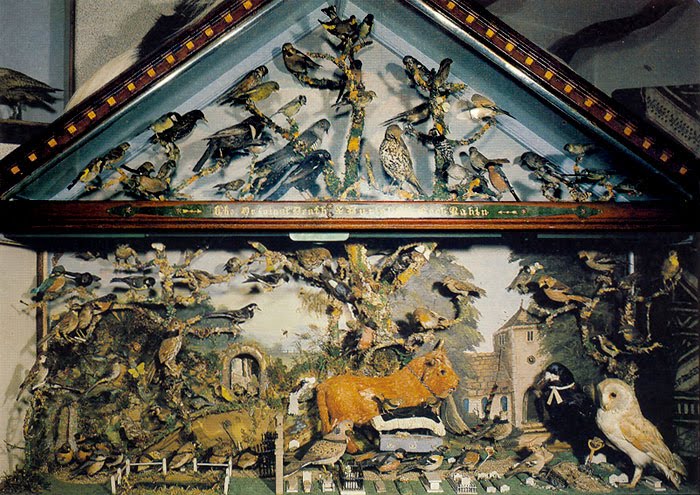
My friend Pat Morris--who spoke on Walter Potter at our recent Congress for Curious People-- loaned several of his own Potter pieces to the exhibition, most notably "The Death of Cock Robin, a truly epic tableaux depicting the funeral procession of the fabled Cock Robin as recounted in the well-known Englist nursery rhyme "Who Killed Cock Robin." This spectacular piece, as the Guardian describes, includes "more than 100 birds including a weeping robin widow and an owl gravedigger who has tumbled some tiny bones out of the soil while preparing space for the dead robin." For a visual (but please note: this image simply does not do the piece justice!), see third image down.

Besides being a collector of great proportion, Mr. Morris is also the author of the only extant book on Mr. Potter and his work, the lavishly illustrated and encyclopedic Walter Potter and His Museum of Curious Taxidermy, which you can buy in hardback or paperback by clicking here or here, respectively. You can also find out more about Potter, his work and his history by visiting the Ravishing Beast website by clicking here. You can read the full Genius or grotesquery?" article on the Guardian website by clicking here. To find out more about this exhibition--which will be on at least till Christmas--and the very curious Museum of Everything, click here.

Thanks to friend, friend-of-the-blog, and many time Observatory lecturer John Troyer for alerting me to this article!

Upcoming Observatory Event: "Swallowed and Saved: The Chevalier Jackson Foreign Body Collection and the Art it Has Inspired," Saturday, October 16


My friend Michelle Enemark is presenting the following event at Observatory this Saturday; looks like it will be a good one!

Swallowed and Saved: The Chevalier Jackson Foreign Body Collection and the Art it Has Inspired
An illustrated reading by artist Lisa Wood and author Mary Cappello
Date: Saturday, October 16th
Time: 7:00 PM
Admission: $5

An American half-dollar. An unspent matchstick. A beloved miniature swan stowed in a biscuit tin. A beaded crucifix. Tooth roots shaped like a tiny pair of pants. A padlock. Scads of peanut kernels and scores of safety pins. A porcelain doll prised from a throat. A metallic letter Z. A toy goat and tin steering wheel. Frozen twigs. Penny wafers. A Perfect Attendance Pin.

One of the most popular attractions in Philadelphia’s Mutter Museum is the Chevalier Jackson Foreign Body Collection: a beguiling set of drawers filled with thousands of items that had been swallowed or inhaled, then extracted nonsurgically by a pioneering laryngologist using rigid instruments of his own design. How do people’s mouths, lungs, and stomachs end up filled with inedible things, and what do they become once arranged in Dr. Chevalier Jackson’s aura-laden cabinet? Animating the space between interest and terror, curiosity and dread, author Mary Cappello and artist Lisa Wood will stage an illustrated reading based on two distinct but companionate projects to have emerged from Jackson’s foreign body display: Wood’s thirty-three original assemblages (The Swallowing Plates) and Cappello’s nonfiction book, Swallow: Foreign Bodies, Their Ingestion, Inspiration and the Curious Doctor Who Extracted Them (The New Press). Like Jackson’s design and deft manipulation of endoscopic instruments, like his endoscopic illustrations and his scrupulous attention to the nature of each foreign body caught, Cappello and Wood’s work excavates the relationship between corporeality, desire, and the object world. Their dossier of images and of incantatory texts promises to combine the uncanny, the beautiful, and the informative.

Note: Several of Lisa Wood’s plates will be on sale and on view, and attendees will be treated to a sneak preview of Cappello’s book which appears this January 2011, as well as details regarding the re-design and grand re-opening of the Chevalier Jackson Foreign Body Exhibit in the Mutter Museum of the College of Physicians of Philadelphia.

Does every human being have one of these Things to show for himself in his life’s hereafter?: as if to say, here is what is left of me: what’s left of me is that-which-was-once-within-me.

Mary Cappello’s books include Night Bloom; Awkward: A Detour (a booklength essay on awkwardness that was a Los Angeles Times bestseller), and Called Back (a critical cancer memoir that won a ForeWord Book of the Year Award and an Independent Publishers Prize). Some of Cappello’s recent essaying addresses Gunther von Hagens’ bodyworlds exhibits (in Salmagundi); sleep, sound and the silence of silent cinema (in Michigan Quarterly Review); the psychology of tears (in Water~stone Review); and the uncanny dimensions of parapraxis and metalepsis (in Interim). A recipient of the Dorothea Lange/Paul Taylor Prize from Duke University’s Center for Documentary Studies and the Bectel Prize for Educating the Imagination from Teachers and Writers Collaborative, Cappello is a former Fulbright lecturer at the Gorky Literary Institute (Moscow) and a professor of English and creative writing at the University of Rhode Island where she also teaches courses in Literature and Medicine. Swallow will appear in January from the New Press. Her latest book-length project on a single theme is a foray into sound and mood, tentatively titled In the Mood. For more information: http://www.awkwardness.org

Lisa Wood is a San Francisco based artist specializing in Victorian arts and crafts. Incorporating Victorian sensibilities into shadowboxes that memorialize the dead, dioramas that explore the hidden world of insects, mourning jewelry that captures the essence of the human spirit, and other curiosities that were inspired by what was collected, constructed and treasured at the time. This was an era when lingering disease and sudden death were inexplicable and everyday perils; an era when the very concepts of art and nature were challenged by technological innovations such as photography and medicine.

These fascinations join her work to the list of artists known as Victorian Revivalists.

Lisa sells her work to smaller boutiques and galleries as well as private collectors around the country. Her Swallowing Plate collection as well as her insect dioramas can be viewed at Gold Bug in Pasadena, the catalog is available at the Mutter Museum Store in Philadelphia.

For more information please visit: Lisa Wood Curiosities and Gold Bug.

To find out more, click here. You can get directions to Observatory--which is next door to the Morbid Anatomy Library (more on that here)--by clicking here. You can find out more about Observatory here, join our mailing list by clicking here, and join us on Facebook by clicking here.

Experimental Treatment Could Fight Muscular Dystrophy

(HealthDay News) -- Injecting a therapeutic molecule into muscle appears to jump-start the production of a crucial protein that's missing in patients with Duchenne muscular dystrophy, British researchers report.

The treatment so far is only applicable to about 13 percent of people with the debilitating and ultimately fatal disease, but scientists are hopeful that similar molecules might expand the treatment to a wider range of patients.

Duchenne muscular dystrophy affects about one in 3,500 males, and involves a progressive wasting of muscle due to a genetic inability to produce the protein dystrophin, a key component of muscle structure. No treatments are available for the illness, and most of those affected die by age 30.

Recently, molecules called antisense oligonucleotides have shown some promise. These molecules work by "skipping over" portions of the defective gene that would otherwise block dystrophin production. Read more...

Cancer prostate

"Portrait of the Professor of Medicine Jan Bleuland," Pieter Christoffel Wonder, 1808

The Romantic painters -- especially the Dutch Romantics -- were influenced by the landscapes, portraits and still-lifes of the Dutch 17th-century masters. Pieter Christoffel Wonder (1777-1852) painted a fascinating "Portrait of the Professor of Medicine Jan Bleuland" (1818), with the self-confident, bourgeois doctor standing in front of a skeleton draped with red arteries. It could have been part of Rembrandt's "Anatomy Lesson" of 1632 -- portraying the same fascination with the interior workings of the human body.

Found in a review of the exhibition "Masters of the Romantic Period -- Dutch Painting 1800-1850" at the Kunsthal on the Wall Street Journal; you can read the article by clicking here, and find out more about the exhibition by clicking here. Image found on the Collectie Utrecht website which can be seen by clicking here.

For another peek at Jan Bleuland at work, see this recent post.

The AFIP lives on (sort of)

The long, strange, sad, sometimes bizarre tale of the AFIP's demise continues.  I have written on what has happened in the past following the BRAC announcement in 2005.  On September 30th the AFIP closed its doors to civilian consultations.  The newly formed Joint Pathology Center expected to open next Spring will offer DOD and VA consultations, education and continue telepathology consultations for military clients.

The real tragedy, in my opinion, of AFIP's closing the loss of a significant public health institution.  For decades the AFIP provided anatomic pathology services that could not be provided for by others or paid for by others in addition to their military-specific duties such as forensics and toxicology.  The breadth and depth of expertise given their unique role and the material sent for consultation contributed significantly to our understanding of human disease and pathology.  1000s of manuscripts, book chapters and courses have trained tens of thousands of pathologists and physicians.

Long story very short -- I think the AFIP suffered from several problems that could have been prevented with some leadership and vision:

1.  Lack of mentorship.  Decades past after Mostofi-Sesterhan; Enzinger-Weiss; Ishak-Goodman, etc... without anyone to follow in the legacy.  Talent was not recruited nor retained.  

2.  Lack of molecular.  Without rapid access to frozen tissue not being a hospital-based institution, while AFIP did its share of morphology with classification of tumors it could never make the leap to molecular on an equally large scale.  

3.  Lack of business plan.  I think the AFIP could have been a profitable organization with the right kind of infrastructure in place to appropriately bill and collect for technical and professional services from non-DOD/VA clients.  The American Registry of Pathology failed in this regard to its mission.

4.  What was the real value of the AFIP? The repository of over 3 million accessions as wet tissue, slides and blocks were kept forever.  The problem when you start to analyze the repositories "worth" was the actual condition of the tissue, slide and blocks and amount, or lack of, clinical history and follow up to correlate with the morphology.

Now in the wake of Bostwick Laboratories first forming "AFIP Laboratories", later changed to "AIP Laboratories" which was quickly disestablished, comes an announcement from former AFIP consultants that they have formed "Inova Pathology Institute". 

A couple points -- is it a positive to continue to include "Institute"?  How about "Inova Pathology Asssociates"?  The byline mentions "most difficult cases from physician offices..." Does this mean primary diagnostic services in addition to consultations?  I would have hoped that the failed Bostwick experiment showed this is a difficult model to sustain.

Sent via E-mail: 

October 4, 2010

Dear Physician:

As you may know, the Armed Forces Institute of Pathology (AFIP) closed its doors on September 30, 2010.

However, we are pleased to announce that AFIP's team of internationally renowned pathologists is still available to serve you. We have joined the Inova Pathology Institute (IPI), a comprehensive diagnostic anatomical pathology reference laboratory in Fairfax, Virginia.

IPI provides a full spectrum of expert pathology services. Led by AFIP's world-class second opinion subspecialty experts, IPI is routinely called upon to review the most difficult cases from physician offices, hospitals and laboratories around the world.

IPI offers you the same high quality clinical services you received from AFIP, including:

a.. Dedicated, organ-specific pathology experts

b.. Definitive diagnostic and consultative support

c.. State-of-the-art laboratory

d.. Fast turnaround time to provide answers more quickly

e.. A continuum of diagnostic expertise for your outpatient and inpatient cases

f.. Flexible billing policies and third-party billing

We look forward to continuing to provide you and your patients with leading-edge pathology services. Visit our Web site at http://www.inovapathologyinstitute.org for more information or to request a consultation. If you prefer, you can call us at 703-645-6190.

Sincerely,

Prakash Jha, M.D., M.P.H.
Medical Director
Inova Pathology Institute

Researchers Reluctantly Admit Mediterranean Diet Beats Diabetes Drugs for Controlling

(NaturalNews) For the first time, a long-term health study has demonstrated that the Mediterranean diet may help diabetes patients control their blood sugar without the use of medication.

"A Mediterranean-style diet is a very important part in the treatment of diabetes," said endocrinologist Loren Greene of New York University Medical Center, who was not involved in the study. "We knew that, but there just hasn't been a good study to confirm this before."

In a study published in the Annals of Internal Medicine, researchers assigned 215 overweight, adult residents of Naples, Italy, to adhere to one of two diets. Participants in one group were assigned to follow a Mediterranean diet -- eating large quantities of fruits, vegetables, whole grains and certain healthy fats such as olive oil; favoring lean protein sources such as nuts, poultry and fish; and gaining no more than half their daily calories from carbohydrates. Read more...

Lose weight quick

Simplified Framingham Model May Miscalculate Risk for Millions

SAN FRANCISCO -- September 9, 2010 -- A method that is widely used to predict the risk of a major coronary event may over- or under-estimate risk for millions of patients in the United States, according to a study appearing online first in the Journal of General Internal Medicine.

The method in question is the simplified version of the so-called Framingham model, which is used to estimate a patient's 10-year risk of a myocardial infarction (MI), stroke, or other coronary event based on risk factors such as age, cholesterol levels, blood pressure, and smoking.

National guidelines recommend using the risk estimates generated by the Framingham model to classify patients as among 1 of 3 risk groups. Guidelines recommend more aggressive strategies to treat cholesterol in patients classified into higher-risk groups.

The original Framingham model uses a complicated mathematical equation to calculate risk, while the simplified version is based on a point system, with a certain number of points for each risk factor. Read more...

Heart Care

New and Undefined Diseases

These days, common diseases present themselves completely different from what they used to be like in former times – and many other diseases appear far more frequently than they did 20 to 50 years ago.

For instance, there are viruses found now, which did not exist before – and they cause new diseases. Bacteria – much feared in earlier days - today, appear completely differently, and are frequently significantly more aggressive, due to the deployment of antibiotics. Ancient diseases – former scourges of mankind – such as tuberculosis or poliomyelitis have almost disappeared.

However, the largest increase found these days is with autoimmune diseases that cause the body to turn against its own organs. Suchlike diseases are, for instance, polyarthritis, colitis ulcerative, MS, and probably also prostatitis. Furthermore, this applies to the formerly rare autoimmune thyroiditis (Hashimoto-thyroiditis), which is currently the fastest growing disease within the US. Unfortunately, it is frequently believed that the cause for those diseases is unknown. However, we do know that all those conditions are based upon various partial causes, which – in combination – actually release the respective disease. Usually, those partial causes are not even sought to be identified. Read more...

Healthy blood

Widely Used Plastics Chemical Linked to Testosterone Boost

(HealthDay News) -- Exposure to the plastics chemical bisphenol A (BPA) can affect men's testosterone levels, a new study has found.

BPA is used in a large number of consumer products, including food and drink containers. A number of countries have moved to ban the use of the chemical in the manufacture of baby bottles and other feeding items.

In the new study, an international team of researchers analyzed data from 715 Italian adults, aged 20 to 74. They found that their average BPA exposure was more than 5 micrograms per day, which is slightly higher than recent estimates for the U.S. population.

Higher BPA exposure was statistically associated with hormone changes in men; specifically, small increases in levels of testosterone in the blood, according to David Melzer, professor of epidemiology and public health at the Peninsula Medical School in Exeter, U.K., and colleagues. Read more...

Detox and cleanse

Monitoring of Kidney Health Urged for Injection Drug Users

(HealthDay News) -- Injection drug users, particularly those with HIV, need to be carefully monitored for poor kidney function and considered for medical treatments when appropriate, researchers report.

In a new study, U.S. scientists analyzed the presence of proteinuria (excess excretion of protein in the urine, which can lead to kidney failure and an increased risk of cardivascular disease) in 902 injection drug users, including 273 who were HIV-positive. Overall, about one-quarter of the injection drug users had proteinuria and the prevalence was nearly three times higher among those with HIV (45 percent) than among those who were HIV-negative (16 percent).

Along with HIV infection, other factors that were linked to a higher prevalence of proteinuria were being unemployed, older age and having diabetes, hepatitis C infection or high blood pressure, said Shruti H. Mehta, of the Johns Hopkins Bloomberg School of Public Health, and colleagues. Read more...

Aging system

A Stone-age prescription

Some of us have a lot to learn about health and our cave-dwelling ancestors

Newspaper section: Mylife http://www.bangkokpost.com/advance-search/?papers_sec_id=12
A life with success and wealth is a desirable one. But a long life of suffering is definitely a miserable one.

While we are still young, we usually think of life as easy and with happy moments. That's why many people, particularly the young, tend to spend their lives living recklessly. For instance, many spend a lot of time smoking, drinking, not getting enough quality sleep and pushing themselves beyond their limits.

Then they wonder why they start to lose their precious youthful looks sooner than they thought they would.

Some examples of the signs include: Their faces look dry and sunken, their eyes lose their glistening sparkle and dark patches develop around them.

This phenomenon is something is commonly called "human metamorphosis".

To live a careless life is the quickest way to turn a young homosapien into an ageing one. They can even look elderly even in their teens.
Read more...

Immunice Support

Infidelity Rises When She Makes More Than He Does

(HealthDay News) -- A new study finds that men are more likely to cheat if their income is much lower than what their wife or female partner makes, while women are more likely to fool around if they make more than their husband or male partner.

The findings suggest that disparities in moneymaking play a significant role in infidelity, at least among the young couples they studied.

"With women, they were less likely to engage in infidelity the less money they make relative to their husband," said study author Christin Munsch. "But for men, the less money you make relative to your spouse, the more likely you are to engage in infidelity."

Munsch, a graduate student at Cornell University, said she came up with the idea of studying the effects of income on infidelity after hearing from a friend who has cheated on his partner. He told Munsch that "she made all the money, she had all the friends, and he'd moved up there to be with her. He felt completely powerless."

While there's been previous research into infidelity, it didn't look into differences in income among couples, Munsch said. Read more...

Female Sexual health

Confused About Coconut Oil?

I just read in your article on "inflammatory responses" that coconut oil is one item to avoid. If I apply coconut oil to my skin to address dryness, can it make its way into my system and cause any problems?

The reason I recommend avoiding coconut oil in the diet is because it is a highly saturated fat (it's one of the few saturated fats that doesn't come from animals). Like other saturated fats, coconut oil can raise cholesterol levels and, therefore, should play only a very limited role, if any, in your diet. In the past, coconut oil was widely used in movie popcorn, candy bars and commercial baked goods but has been phased out of many of these products because of consumer opposition to unhealthy tropical oils.

And incidentally, despite the ongoing internet buzz that coconut oil can promote weight loss, there's no scientific evidence to back up those claims. Lauric acid, the main fatty acid found in coconut oil, has shown positive effects as an anti-viral agent in treating herpes, but all in all, I recommend avoiding dietary sources of coconut oil. Read more...

Healthy blood, blood disorders

International Alliance for the Prevention of AIDS

Join us for the opportunity of a lifetime. Be involved in something incredible.

Summer 2011.

- Take part in the fight against the HIV/AIDS epidemic in Southeast India -

- Develop skills as a teacher and learn how to interact with different demographics -

- Immerse yourself in the rich Indian culture and lifestyle -

- Make lifelong friends and connections from both the U.S. and India -

- Gain valuable and impressive experience for any resume -

Interested?

Come to one of our informational sessions in the Student Union:

Thurs Oct. 7th 7pm-8pm Copper
Mon Oct. 18th 4pm-5pm Picacho
Sat Nov. 6th 2pm-3pm Presidio
Tues Nov. 9th 7pm-8pm Madera
Wed Nov. 17th 5pm-6pm Picacho
Sun Nov. 21st 11am-12pm Sabino
Mon Nov. 29th 3pm-4pm Sabino
Fri Dec. 3rd 4pm-5pm Sabino

Check out iapaindia.org and IAPA Summer Volunteer Program 2011 on facebook.
Send questions to iapa2011@gmail.com