FDA Approves Gene-Hacked CRISPR Pigs for Human Consumption

The US Food and Drug Administration has approved a type of CRISPR gene-edited pig for human consumption.

The US Food and Drug Administration has approved a type of CRISPR gene-edited pig for human consumption.

As MIT Technology Review reports, only an extremely limited list of gene-modified animals are cleared by regulators to be eaten in the United States, including a transgenic salmon that has an extra gene to grow faster, and heat-tolerant beef cattle.

And now a type of illness-resistant pig could soon join their ranks. British company Genus used the popular gene-editing technique CRISPR to make pigs immune to a virus that causes an illness called porcine reproductive and respiratory syndrome (PRRS).

It's the same technology that's been used to gene-hack human babies — experiments that have proven far more controversial — and develop medicine in the form of gene therapies.

The PRRS virus can easily spread in factory farms in the US and cause the inability to conceive, increase the number of stillborn pigs, and trigger respiratory complications, including pneumonia.

It's been called the "most economically important disease" affecting pig producers, since it can have a devastating effect on their bottom lines. According to MIT Tech, it causes losses of more than $300 million a year in the US alone.

Genus' gene-editing efforts have proven highly successful so far, with the pigs appearing immune to 99 percent of known versions of the virus.

Using CRISPR, the company knocked out a receptor that allowed the PRRS virus to enter cells, effectively barring it from infecting its host.

Beyond the respiratory illness, scientists are using gene-editing to make pigs less vulnerable or even immune to other infections, including swine fever.

But before we can eat a pork chop from a gene-edited pig, Genus says that it will have to lock down regulatory approval in Mexico, Canada, Japan, and China as well, the United States' biggest export markets for pork, as MIT Tech reports.

The company is hoping gene-edited pork could land in the US market as soon as next year.

But whether you'll actually know if you're eating meat from a pig that had a virus receptor turned off using a cutting-edge DNA modification technique is unclear.

"We aren't aware of any labelling requirement," Genus subsidiary Pig Improvement Company CEO Matt Culbertson told MIT Tech.

More on CRISPR: Scientist Who Gene-Hacked Human Babies Says Ethics Are "Holding Back" Scientific Progress

The post FDA Approves Gene-Hacked CRISPR Pigs for Human Consumption appeared first on Futurism.

See the original post here:
FDA Approves Gene-Hacked CRISPR Pigs for Human Consumption

China Attacks Trump With Sassy AI-Generated Music Video

As the economy roils and tensions escalate, China has dealt a devastating blow to Donald Trump in the form of an AI music video.

As the world economy reels from President Donald Trump's so-called "reciprocal tariffs," the trade war between China and the US is escalating to new heights.

Nowhere is that more evident than in China's wild clapback in the form of an AI-generated music video blasting the United States, which came hours after Trump announced a 34 percent tax on Chinese imports.

The English-language China Global Television Network (CGTN) released the song, called "Look What You Taxed Us Through" ahead of Wall Street's worst single-day performance since 2020, during the throes of the pandemic. The song's lyrics are written from the point of view of an American consumer, blasting Trump's economic policy and daily life in the US more broadly. While the music video is AI-generated — a fact the CGTN advertises, unlike some American slopaganda — it also makes use of clips and audio from real sources like Trump rallies, Tesla protests, and American social media.

For many Americans, "Liberation Day," hailed by Trump's administration, means shrinking paychecks and rising costs. Tariffs hit, wallets quit: low-income families take the hardest blow. As the market holds its breath, the toll is already undeniable. #LiberationDay #CGTNOpinion pic.twitter.com/RzXFFVHoFg

— CGTN (@CGTNOfficial) April 3, 2025


"Groceries cost a kidney, gas a lung. Your 'deals'? Just hot air from your tongue," the song opens, overlaid with B-roll from Tesla protests and audio from inflation-wary Americans. It continues: "Elon's satellites crash, Bezos' wealth sinks, the GDP's limping, the Fed's out of tricks, your 'patriot tax' made Wall Street sick."

While harsh remarks from US officials and mainstream media about China are nothing new, China rarely hits back with this much vinegar. Its appeal to US citizens to question their economy is clear: "CEOs buy yachts, we can't afford a stew!"

But Beijing's retaliatory strategy goes far beyond campy propaganda. China has matched the US' tariffs with 34 percent tariffs on its own, sharply escalating a seven-year trade war. It also announced controls on rare earth exports, which could be a major blow for American manufacturing, as China produces about 90 percent of the world's refined rare earth metal.

Unfortunately for people in the US, the CGTN's depiction isn't far off. Responding to the terrible rotten stock market dive, Federal Reserve chair Jerome Powell noted that Trump's tariffs are "larger than expected," adding that increased inflation, lost jobs, and stagnant economic growth are likely.

"We face a highly uncertain outlook with elevated risks of both higher unemployment and higher inflation," Powell fretted.

US business leaders were a little less restrained.

"There will be blood," was the message from JP Morgan's Bruce Kasman, whose team released an analysis of the tariffs on Thursday. They warned that the risk of a recession has skyrocketed from an already uncomfortable 40 percent to a whopping 60. "At a basic level," Kasman's team calls the tariffs a functional tax increase on US citizens and businesses.

So far, Trump's tariffs have wiped $2.5 trillion in US stock market value, and it's anyone's guess when we might hit the bottom. At least we'll get some crafty Chinese propaganda when we do.

More on China: Tesla Forced to Change Name of "Full Self-Driving" in China, Since Its Cars Can't Fully Drive Themselves

The post China Attacks Trump With Sassy AI-Generated Music Video appeared first on Futurism.

Read more here:
China Attacks Trump With Sassy AI-Generated Music Video

China Is Hosting The World’s First Foot Race Between Humans and Robots

In the race to build the best humanoid robots, China is literally ahead of the pack as it prepares for the world's first human-robot race.

Track Stars

In the race to build the best humanoid robots, China is quite literally ahead of the pack.

As the South China Morning Post reports, the Beijing Economic-Technological Development Area — or E-Town — is hosting 12,000 humans and humanoid robots from more than 20 companies in a half-marathon race this April.

The race will be roughly 13 miles, and robotic competitors both cannot have wheels and must stand between 1.5 and 6.5 feet tall. In a statement, E-Town added that "competing robots must have a humanoid appearance and mechanical structure capable of bipedal walking or running movements."

Though this seems to be the world's first race explicitly pitting bipedal humans against robots, it won't be the first time a humanoid robot has taken part in a Chinese atheletic competition.

Last fall, a bipedal robot called Tiangong — not to be confused with China's space station of the same name, which translates to "heavenly palace" — jumped into Beijing's Yizhaung half-marathon towards its end. Though it only ran about 100 meters and wasn't particularly fast, the robot got a medal because it crossed the finish line (a participation trophy if we've ever heard of one).

At the Beijing Yizhuang Half #Marathon on the morning of Nov. 10, the #Beijing humanoid #robot "Tiangong" entered the racecourse and crossed the finish line alongside the runners. #funinbeijing pic.twitter.com/DQM1zjxneK

— Beijing Daily (@DailyBeijing) November 10, 2024

Dog Gone It

Just a few week after Tiangong's surprise marathon debut, the the RAIBO2 robodog competed in a full marathon weeks later in South Korea. Though the adorable quadruped was significantly faster than Tiangong, it still took nearly four hours and 20 minutes to run the 26.2 mile race — nearly double the time of the human winner, who clocked in at around two hours and 36 minutes.

Because it's neither Chinese nor bidepal, RAIBO2 will unfortunately not be involved in the E-Town half-marathon. According to the state-run Xinhua news agency, however, Tiangong will be one of the participants and will purportedly be capable of running 10 kilometers (6.2 miles) per hour by the time the race rolls around.

That same agency also reported that later this year, in August, Beijing will be hosting an all-robot sporting event that not only features track and field races, but also football — unclear on whether the outlet is using the American or European definition — and "comprehensive skills and other application scenarios."

Though we can't known how fast these running robots will be until we actually watch them, we can't wait to watch.

More on unique robots: Inventor Builds Six Robot Copies of Himself, Uses One to Give Speeches and Take Questions From Audience

The post China Is Hosting The World’s First Foot Race Between Humans and Robots appeared first on Futurism.

See the original post:
China Is Hosting The World’s First Foot Race Between Humans and Robots

Chinese Police Deploy Rolling BB-8-STyle Robot to Patrol Streets, Chase Down Suspects

In China, police are now patrolling the streets with a rolling spherical robot that can chase down suspects and beat them in a fight.

Imperial Police

In Eastern China, police are now patrolling the streets with a rolling robot that can chase down suspects — and, they say, beat them in a fight.

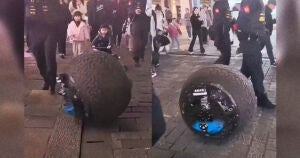
As the South China Morning Post reports, cops in the city of Wenzhou in Zhejiang province have lately been flanked by the spherical robot that looks a bit like a militarized version of the cutesy BB-8 robot in "Star Wars."

Named the "Rotunbot" or "RT-G" for short, this spherical robot was created by researchers at Zhejiang University on behalf of a Shenzen-based outfit called Logon Technology. It reportedly weighs about 275 pounds and travels up to 22 miles-per-hour — and according to Wang You, an associate professor who worked on it, only takes a few seconds to reach that speed.

"This robot can cope with dangers such as falling or being beaten," Wang told SCMP, "and can perform tactical actions such as enemy identification, tracking, and capture after modular modification."

Equipped with net-guns, tear gas, and speakers, the robot is also reportedly pretty good at scaring off any would-be attackers.

"If you win the fight, you’ll end up in jail," the robot was heard saying in a recent fight simulation viewed by the SCMP. "If you lose the fight, you’ll end up in hospital."

Burning Rubber

While "Star Wars" aesthetics are very much present in RT-G's design, its autonomous operations are more akin to the 2010 sleeper horror hit "Rubber," which follows a sentient tire as it wreaks havoc across a desertscape.

Though there don't seem to have been any public demonstrations of the robot operating autonomously yet, a promotional video released by Logon ahead of RT-G's deployment in Wenzhou suggests it can navigate various types of situations by itself.

"Narrow terrain, extreme weather, dangerous work environments, violent conflicts and wars, all pose huge threats to human life and activities," reads a translation of the video on the r/Cyberpunk subreddit. "Thus an amphibious, intelligent robot emerged to replace humans in these style environments."

It's a far cry from the crappy police robots that have been repeatedly deployed and recalled by law enforcement in New York — and honestly, this one is a lot scarier.

More on cop-bots: Eric Adams Has Been Indicted, But His Crappy Subway Robot Will Be "Redeployed"

The post Chinese Police Deploy Rolling BB-8-STyle Robot to Patrol Streets, Chase Down Suspects appeared first on Futurism.

Read more:
Chinese Police Deploy Rolling BB-8-STyle Robot to Patrol Streets, Chase Down Suspects

Astronauts Hear Strange Sounds Coming From Boeing’s Cursed Starliner

Over the weekend, stranded NASA astronaut Butch Wilmore encountered strange sounds coming out of Boeing's much-maligned Starliner.

Strange Music

Over the weekend, stranded NASA astronaut Butch Wilmore heard bewildering sounds coming out of Boeing's much-maligned Starliner, which carried him to the space station for what was supposed to be an eight-day trip that's now got him stuck on the orbital outpost until next year after equipment failures on the shuttle.

"I’ve got a question about Starliner," he told mission control in Houston over the radio. "There’s a strange noise coming through the speaker... I don’t know what’s making it."

While NASA later confirmed that the source of the noise was mostly benign, it's more of the type of story that Boeing has definitely been hoping will go away.

Its spacecraft, which has been docked at the International Space Station since early June, has already been plagued with technical issues. Helium leaks affecting its propulsion systems forced NASA to reevaluate the mission, concluding last month that it wasn't safe enough for Wilmore and colleague Sunita Williams' return. Instead, to the chagrin of Boeing, they'll return on a future SpaceX trip.

While investigating the unusual situation, Wilmore held his microphone up to Starliner's speakers.

"Alright Butch, that one came through," Houston told Wilmore. "It was kind of like a pulsing noise, almost like a sonar ping."

"I'll do it one more time, and I'll let y'all scratch your heads and see if you can figure out what's going on," Wilmore radioed. "Alright, over to you. Call us if you figure it out."

Bumps in the Night

The strange sounds, as shared by meteorologist Rob Dale, manifest as an ominous knocking noise.

Fortunately, unlike Boeing's trouble with Starliner's propulsion system, it doesn't sound like it was anything particularly serious this time — though the explanation does read as fairly amateurish on Boeing's part.

In a statement to Ars Technica on Monday, NASA said that the "feedback from the speaker was the result of an audio configuration between the space station and Starliner."

"The space station audio system is complex, allowing multiple spacecraft and modules to be interconnected, and it is common to experience noise and feedback," the statement reads.

It's not the first time astronauts have encountered strange noises coming from their spacecraft. For instance, China's first astronaut Yang Liewei noticed strange sounds that sounded like "knocking an iron bucket with a wooden hammer" during his voyage in 2003. The noise later turned out to be decreasing air pressure triggering changes in the structure of the vessel.

Starliner is scheduled to make its return without Williams and Wilmore on board as early as Friday. The two astronauts are instead getting a ride from Boeing's competitor SpaceX in February — an unfortunate end to a disastrous first crewed test flight.

More on Starliner: Boeing Execs Yelled at NASA Leaders When They Didn't Get What They Wanted

The post Astronauts Hear Strange Sounds Coming From Boeing's Cursed Starliner appeared first on Futurism.

Go here to see the original:
Astronauts Hear Strange Sounds Coming From Boeing's Cursed Starliner