1 in 5 Americans have trouble communicating with their doctor and 1 in 10 feel disrespected. How to help?

A 2001 survey by the Commonwealth Fund found that doctor-patient communication often fell short. One in 5 American adults had trouble communicating with their doctors, and 1 in 10 felt they had been treated disrespectfully during a recent health care visit.

Just funded through a generous $42-million grant, the University of Chicago aims to fix the communication errors and bring the patient-physician relationship back where it belongs.

Here is the example that started the whole process:

Kay Bucksbaum, whose husband made multi-billion fortune developing shopping centers around the world, said she was inspired by Dr. Mark Siegler, a medical ethicist at the University of Chicago who became the couple's internist when they moved to Chicago from Iowa 10 years ago.

In contrast, she recalled a doctor years ago who didn't listen to her when she told him what she thought was wrong with her -- and didn't apologize when she turned out to be right.

When her husband needed surgery, she said, Siegler "took my husband by the hand to meet the surgeon, introduced him, and told the surgeon something about my husband. He even scrubs up and watches his patients' surgeries when he can, she said. "And he encourages patients to call him "Mark."

The video below introduces the Bucksbaum Institute for Clinical Excellence which is funded through $42 million grant to the University of Chicago to create a unique initiative that aims to improve the doctor-patient relationship and communication in medicine:

Disclaimer: I am an Allergist/Immunologist and Assistant Professor of Medicine and Pediatrics at the University of Chicago.

NBC video:

References:

New Bucksbaum Institute fosters doctor-patient communication
Benefactor Gives U of Chicago $42 Million to Work on Bedside Manner
A $42 Million Gift Aims at Improving Bedside Manner

Posted at Clinical Cases and Images. Stay updated and subscribe, follow us on Twitter and connect on Facebook.


Source:
http://feeds.feedburner.com/CasesBlog

Antiphospholipid antibody syndrome (APS)

From The Lancet:

Graham Hughes, who first described antiphospholipid syndrome (APS) in 1983, urged for more efforts to raise awareness of this disorder. APS often remains undiagnosed and untreated with catastrophic consequences, such as multiple miscarriages, or stroke at a young age.

Clinical features of APS
Clinical manifestations of antiphospholipid syndrome (APS) include:
- venous, arterial, and small-vessel thrombosis
- pregnancy loss
- preterm delivery for patients with severe pre-eclampsia or placental insufficiency
- cardiac valvular disease
- renal thrombotic microangiopathy
- thrombocytopenia
- haemolytic anaemia
- cognitive impairment
Antibodies
Antiphospholipid antibodies promote activation of endothelial cells, monocytes, and platelets; and overproduction of tissue factor and thromboxane A2 (procoagulants). Complement activation might have a central pathogenetic role.


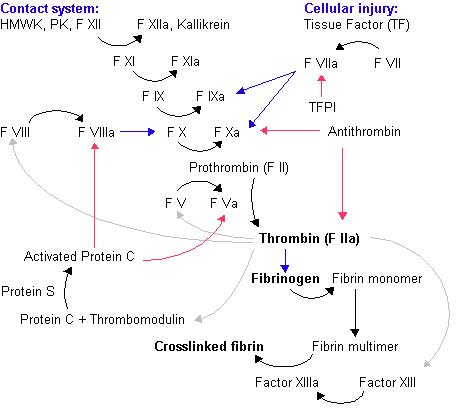
The coagulation cascade. Black arrow - conversion/activation of factor. Red arrows - action of inhibitors. Blue arrows - reactions catalysed by activated factor. Grey arrow - various functions of thrombin. Image source: Wikipedia

Of the different antiphospholipid antibodies, lupus anticoagulant is the strongest predictor of clinical presentation.
Treatment of APS
Therapy of thrombosis is based on long-term oral anticoagulation (warfarin). Patients with arterial events should be treated aggressively.
Primary thromboprophylaxis is recommended in patients with systemic lupus erythematosus (SLE) and in obstetric antiphospholipid syndrome. Obstetric care is based on treatment with aspirin and heparin.
Hydroxychloroquine is a potential additional treatment for APS. Possible future therapies for non-pregnant patients with antiphospholipid syndrome are statins, rituximab, and new anticoagulant drugs.

References

Antiphospholipid syndrome. The Lancet, Volume 376, Issue 9751, Pages 1498 - 1509, 30 October 2010.
Raising awareness of antiphospholipid antibody syndrome. The Lancet, Volume 375, Issue 9717, Page 778, 6 March 2010.

Posted at Clinical Cases and Images. Stay updated and subscribe, follow us on Twitter and connect on Facebook.


Source:
http://feeds.feedburner.com/CasesBlog

Alarming new stimulant: Bath salts labeled “not for human consumption”

Update 09/21/2011: DEA Moves to Make 'Bath Salts' Illegal as Overdoses Rise

What are these “bath salts”?

The abuse of psychoactive “bath salts” (PABS) has become commonplace, and patients with PABS overdoses are presenting to emergency departments with increasing frequency. The main ingredient of the synthetic designer drugs in these bath salts, which are not related to any hygiene product, is methylenedioxypyrovalerone (MDPV).

What is the clinical presentation?

From the NYTimes: "Doctors could not believe what he was seeing this spring in the emergency room: people arriving so agitated, violent and psychotic that a small army of medical workers was needed to hold them down.

They had taken new stimulant drugs that people are calling “bath salts,” and sometimes even large doses of sedatives failed to quiet them. Director of Poison Center. “If you gave me a list of drugs that I wouldn’t want to touch, this would be at the top.”

Bath salts contain man-made chemicals like mephedrone and methylenedioxypyrovalerone, or MDPV, also known as substituted cathinones. Both drugs are related to khat, an organic stimulant found in Arab and East African countries that is illegal in the United States." These products are easily obtained over the Internet under such names as Ivory Wave or Vanilla Sky.

What to do when evaluating and treating a patient intoxicated with psychoactive “bath salts” (PABS)?

Clinicians need to be aware of several issues (source: NEJM):

- severity and potential lethality from overdoses often require admission to the intensive care unit (ICU)

- routine drug screens do not detect PABS

- PABS can be cut with other psychoactive substances, which can confound the clinical presentation

- patients may need physical restraints and high doses of sedatives to prevent self-harm or harm to others.

Treatment is largely supportive, with IV benzodiazepines (for sedation or to control seizures) and IV fluids, particularly if there is rhabdomyolysis

References:

An Alarming New Stimulant, Sold Legally in Many States. NYTimes.
“Bath Salts” Intoxication. NEJM.

Comments from Google+:

Nancy Onyett, FNP-C: UDS cannot screen for this yet it has severe effects on CV/neuro system acting like cocaine. People are snorting it smoking it, a few cases of injection with death. Also, "Spice" herb is being used in rampant amounts Dominion Labs is who I use for UDS which picks up metabolites of Spice. DEA has it listed as a Class I controlled substance. No listing for bath salts yet but there needs to be. Police have an ampule that can check bath salts vs. cocaine. It is a rapid check on the street. Any physician nurse practitioner working in FP needs to be aware of Spice and bath salts. Unfortunately, there is not a metabolite designated yet to pick up on UDS , soon to be if DEA classifies the drug. Also, for those that don't know
Spice is flavored but looks just like Marijuana. Police have an ampule to differentiate the two on street.
Ian Miller: Interested from an emergency department nurse perspective on how you manage these highly agitated patients (refractory to sedation) that are also potentially very unwell. Do you have a specialized treatment area within the ED, do you just use lots of manpower to restrain?
A very difficult management situation with respect to patient and staff safety.
Joan Justice: Are people doing this "for fun"? What is fun about this? I read today that doctors have to put some of these patients under anesthesia because they cannot restrain or calm them. What a drain on resources, and again, what is the benefit for the user here?

Posted at Clinical Cases and Images. Stay updated and subscribe, follow us on Twitter and connect on Facebook.


Source:
http://feeds.feedburner.com/CasesBlog

Presentations from Medicine 2.0 Congress

These are some selected presentations from the 2011 Medicine 2.0 Congress that took place on the Stanford University campus last weekend:

Lee Aase, manager of Syndication and Social Media for Mayo Clinic, has uploaded more than 100 of his presentations on SlideShare.

Other presentations: Epocrates and medical apps.

Posted at Clinical Cases and Images. Stay updated and subscribe, follow us on Twitter and connect on Facebook.


Source:
http://feeds.feedburner.com/CasesBlog

Candace Couse

Candace Couse Landlocked

Candace Couse Landlocked

Candace Couse Landlocked


Candace Couse Landlocked

Calgary based mixed media artist, Candace Couse, works with paint, installation, video, and most interestingly, fiber.  A somewhat recent graduate with a MFA from University of Calgary, Candace creates incredibly detailed knitted anatomical structures.  The images above are from a 2010 show, called Landlocked at the Nickle Arts Museum in Calgary, AB.

Candace says of her work,

My own research—in mixed media—is a discourse with geography, mapping, space/place theory, the body and identity. The conceptual considerations examine the basic human need to acquire territory as a prerequisite to identity, how a loss of territory leads to a breakdown of self inundated with anxiety and loss of security. Most recently, I have completed a short film with The National Film Board of Canada titled, Sick/Malade. The film is a fanciful, endoscopic journey through the knitted body that is violently disrupted by the discovery of a malignant malady. Sick/Malade is currently being marketed for a two year film festival circuit.

View more of Candace’s work on her site, candacecouse.com and keep updated on the progress of her film at the The National Film Board of Canada.

I hope we can view the film soon!


Source:
http://feeds.feedburner.com/streetanatomy/OQuC

Anatomical Heart Tattoo Inspired by Medical Illustrator Sketch

vanessa ruiz heart illustration tattoo

Tattoo by Terri at the Army Navy Tattoo in Newport News, VA.


vanessa ruiz heart illustration tattoo anthony


vanessa ruiz heart illustration

Every once in a while, as an artist, your work can make an unexpected positive impression on a viewer, so much so that they desire your work to become a permanent part of their body.  I had that experience recently, when a reader of Street Anatomy asked me a while back to use an anatomical heart illustration I did in grad school, for a tattoo on his chest.

His name is Anthony and he is a biology undergrad who is applying to medical school.  Anthony actually got the tattoo the same day as his MCAT!  He hopes to someday specialize in interventional radiology, cardiology, or neurology.

I wish him the best of luck and am honored to have a piece of my art as a permanent part of his body!


Source:
http://feeds.feedburner.com/streetanatomy/OQuC

BikeSkull by Dadu Shin

Dadu Shin

Oh man, this illustration has bikes and anatomy!? I’m already in love. This beautiful sketchbook image was done by the extremely awesome Dadu Shin. We’re talking amazing illustration skills, no really, go check out his portfolio now, you won’t be sorry! The serenity and simplicity is good for what ails you. What a breath of fresh air. Click the image to get a closer look.


Source:
http://feeds.feedburner.com/streetanatomy/OQuC

Apex Art Resident Conversation, Wednesday, September 28th, 6:30 PM


For those of you interested in hearing about my month in Seoul, South Korea as part of the Apex Art Outbound Residency program--and seeing some photos as well--you will have a chance next Wednesday, September 28th at the Apex Art Resident Conversation. The event is free is open to the public. Full details follow; Hope to see you there!

Apex Art Resident Conversation
Date: Wednesday, September 28
Time: 6:30 pm
Address: Apex Art, 291 Church Street New York, NY 10013
Joanna Ebenstein, Outbound Resident to Seoul, South Korea, in conversation with past apexart Outbound Residents, including Valerie Crosswhite who participated in the Seoul exchange in 2010.

You can find out more here. Hope to see you there!

Source:
http://morbidanatomy.blogspot.com/feeds/posts/default?alt=rss

The Midnight Archive Episode 2: Occult New York Part 1, Online and Available for Viewing!

As mentioned in this previous post, The Midnight Archive is a new web-based documentary series "centered around the esoteric and always exotic personalities that spring from Observatory," the Brooklyn-based event/gallery space I founded a few years ago. The series is created and directed by film-maker Ronni Thomas, who has plans to upload approximately one new episode per week to the new Midnight Archive website.

Episode two of The Midnight Archive--entitled Occult New York Part 1, and featuring the ever fascinating and many-time Observatory presenter Mitch Horowitz--has just been uploaded is now available for viewing! You can view it above or on The Midnight Archive website.

For more on the series, to see former episodes, or to sign up for the mailing list so as to be alerted to future uploads, visit The Midnight Archive website by clicking here. You can also "like" it on Facebook--and thus be alerted--by clicking here.

Source:
http://morbidanatomy.blogspot.com/feeds/posts/default?alt=rss

Master Pieces from Itinerant Art, Auction Sale of the Fabienne & François Marchal Collection of Fairground Art at Drouot Montaign, Paris


PARIS, FRANCE – Auction sale of the Fabienne & François Marchal Collection of Fairground Art at Drouot Montaigne on September 28-29, 2011. Held by Cornette de Saint-Cyr with nearly 900 lots including a portable Alfred Chanvin & anon. carousel with wooden horses. Selected auction pieces will be shown at Drouot Montaigne from Sept. 7-18. The entire collection will be displayed at the Porte de Versailles exhibition centre from Sept. 23-26.

The Fairground was a major vector of communication in the 19th century, popularizing scientific and medical inventions, as epitomized here by wax anatomical figures from the Palace Museum. The Fabienne & François Marchal Collection is the fruit of many years devoted to the safeguard of a specific aspect of our artistic and cultural heritage.

Among the historic and/or rare items will be some 80 wooden horses and 160 other carousel animals, dating from 1850-1960, including a Van Guyse Noah’s Ark; Spooner centaurs; and rare animals by Mathieu & Bayol. Various target games, wheels of fortune and a music hall shy or bouffes-balles will be among the historic fairground games. There will also be numerous decorative items (monumental figures, caryatides, stall fronts, merry-go-round elements), including large triumphant figures by Alexandre Devos, and salon carousel decorative elements by Anton Benner.

All images from the Cornette de Saint Cyr auction house website; text from The Carousel News and Trader. You can find out more--and bid on these lots and many, many more!--by clicking here.

Source:
http://morbidanatomy.blogspot.com/feeds/posts/default?alt=rss

Theatrum Anatomicum, Caspar Bauhin, 1605


Caspar Bauhin Theaturm Anatomicum 1605
Description: [xvi], 1314 pp. Engraved title page with engraved portrait on verso, engraved armorial device on verso of following leaf; 129 engraved plates included in pagination. (8vo) 7½x4¾, contemporary full vellum, yapp edges, lacking closure ties. First Edition.Page 175, intended for Plate 20 of Book 1 curiously left unprinted, perhaps a prudish expurgation of a depiction of the male reproductive system. Bauhin (1560-1624) was born at Basel and studied medicine at Padua, Montpellier, and Tubingen (under the botanist Leonhard Fuchs). On his return to Basel in 1580, he was admitted to the degree of doctor, and gave private lectures in botany and anatomy. In 1582 he was appointed to the Greek professorship in that university, and in 1588 to the chair of anatomy and botany. He was later made city physician, professor of the practice of medicine, rector of the university, and dean of his faculty. His anatomical publications drew criticism from the followers of Galen, as did his work on human anatomical nomenclature, particularly of the muscles, but his system was adopted by subsequent anatomists. This work has fine dissection plates in greater number than his earlier books. GM-379
Place Published:
Date Published: Frankfurt

Click on images to see larger versions. Text and most images from Live Auctioneers; other image from Elettrogenica.

Source:
http://morbidanatomy.blogspot.com/feeds/posts/default?alt=rss

Upcoming Observatory Events This September

19th century-inspired immersive amusements at Coney Island! Kraftwerk multi-media presentation! Erotic Death in Victorian Art and Fashion! Hope to see you at one or more of these great upcoming Observatory events.

The Making of a 19th Century Spectacle: Artist Talk at The Coney Island Museum
Date: Thursday, September 22
Time: 7:30 PM
Admission: $5
Presented by Morbid Anatomy and The Coney Island Museum
***Location: Off-site at The Coney Island Museum (1208 Surf Avenue, Brooklyn)

On an average day in Coney Island around 1900, a visitor might be able to experience: A midget village modeled on 16th century Nuremberg and featuring its own parliament, hotel, stables with midget ponies, vaudeville house, and midget fire department rushing off to put out imaginary fires; A recreation of the destruction of Pompeii by volcano, San Francisco by earthquake, Galveston by flood, and/or Titanic by iceberg; A recreation village of the head-hunting Bontac Tribe of the Philippines with real tribes-people on display; An immersive spectacular which staged tenement fires every half hour and featured a cast of 2,000; A Boer War reenactment featuring real Boer War veterans; A trip to the moon, under the sea, or to heaven and hell by way of being buried alive in a glass coffin; and, as they say, much, much more.

In the exhibition The Great Coney Island Spectacularium, Observatory's Joanna Ebenstein and artist Aaron Beebe seek--via installation, artifacts, and newly commissioned artworks--to explore, celebrate, and evoke turn of the 20th Century Coney Island as the pinnacle of pre-cinematic immersive and spectacular amusement. The centerpiece of the exhibition is The Cosmorama of the Great Dreamland Fire, an immersive 360 degree spectacle based on the great panoramas and cosmoramas that populated Coney Island in the 19th century. It tells the story--in an immersive blend of image, sound, and light--of the most spectacular disaster in Coney Island history: the complete and dramatic destruction of Dreamland, one of the three great parks that made up turn of the century Coney Island, by fire 100 years ago in 1911. Dreamland was never rebuilt, but had it been, Ebenstein and Beebe are certain it would have given pride of place to a disaster spectacle that allowed visitors to experience the great fire that had once destroyed it. The Cosmorama of the Great Dreamland Fire is their attempt to create this attraction that should have been, and to allow contemporary audiences to experience a 19th century-style immersive spectacle of the sort celebrated in the exhibition.

This Thursday September 22, the crew behind the conception and construction--which include Observatory's Joanna Ebenstein and Wythe Marschall as well as sound engineers, scenic painters, lighting designers, and artisans from the Metropolitan Opera and other institutions--will be on hand at The Coney Island Museum to discuss the making of the piece, answer your questions, and lead guided tours of the exhibition.

World of Kraftwerk: A Journey In Music
Multimedia presentation with musician and writer Stephen Vesecky
Date: Friday, September 23
Time: 8:00 PM
Admission: $5
Presented by Morbid Anatomy

The Autobahn; The Man Machine; The Model. Rising from the ruins of post-war Germany, Kraftwerk created a new artform of sound and light, drawing not on the dominant American culture, but instead looking back to the utopian futurism of Fritz Lang and the Bauhaus architects. Defiant of the rock 'n' roll leviathan, they fashioned their own electronic instruments, with which they invented a new language for pop music. In so doing, they created a blueprint for the musical landscape that we see around us today; hip hop, synth pop, global dj culture, modern dance music--all were inspired by Kraftwerk's obsessive electronic poetry.

Tonight, join musician and writer Stephen Vesecky for a multimedia presentation celebrating and elucidating the unlikely but true story of this incredible band. Dr Maz of Mondo and DeLuxe will spin Kraftwerk-inspired records for the after-party.

Stephen Vesecky has played and toured with many new wave/indie bands including Poundsign, Mahogany, the Aisler's Set, and Still Flyin'. He now writes music for his current project, Strega, DJs at Lolita Bar in Manhattan and Bar Reis in Brooklyn, and creates music for soundtracks and promotional videos.

Erotic Death in Victorian Art and Fashion
An Illustrated Lecture with Professor Deborah Lutz
Date: Friday, September 30th
Time: 8:00 PM
Admission: $5
Presented by Morbid Anatomy

The Victorians had a different relationship to the dead body and dying than we do today. Painters in the late-Romantic style created beautiful men and women ravaged by death; they depicted dying as a moment of climax and aesthetic perfection. Locks of hair were snipped from the corpse and woven into jewelry: a form of mourning that revered the body and its parts, even after death. Body-part stories told of the deep desire to possess the pieces of the famous dead. We will look at some of these paintings and objects, with a view toward recuperating this willingness to dwell with loss itself, to linger over the evidence of death’s presence woven into the texture of life.

Deborah Lutz is an Associate Professor at Long Island University, C.W. Post. Her first book—The Dangerous Lover: Gothic Villains, Byronism, and the Nineteenth-Century Seduction Narrative—traces a literary history of the erotic outcast. Her second book—Pleasure Bound: Victorian Sex Rebels and the New Eroticism—explores mid-Victorian sexual rebellion. She is currently working on a book about the materialism of Victorian death culture and “secular relics”: little things treasured because they belonged to the dead.

Image: Victorian hair plume palette work brooch with seed pearls and curled wire work, circa 1870. Found on the Morning Glory Antiques website.

To be alerted to future events, "like" Morbid Anatomy on Facebook by clicking here or sign up for the Obesrvatory mailer by clicking here. More on all events here. Touy can find out more about these events by clicking here.

Source:
http://morbidanatomy.blogspot.com/feeds/posts/default?alt=rss

How recombinant swollenin from Kluyveromyces lactis affects cellulosic substrates and accelerates their hydrolysis

Background:
In order to generate biofuels, insoluble cellulosic substrates are pretreated and subsequently hydrolyzed with cellulases. One way to pretreat cellulose in a safe and environmentally friendly manner is to apply, under mild conditions, non-hydrolyzing proteins such as swollenin - naturally produced in low yields by the fungus Trichoderma reesei. To yield sufficient swollenin for industrial applications, the first aim of this study is to present a new way of producing recombinant swollenin. The main objective is to show how swollenin quantitatively affects relevant physical properties of cellulosic substrates and how it affects subsequent hydrolysis.
Results:
After expression in the yeast Kluyveromyces lactis, the resulting swollenin was purified. The adsorption parameters of the recombinant swollenin onto cellulose were quantified for the first time and were comparable to those of individual cellulases from T. reesei. Four different insoluble cellulosic substrates were then pretreated with swollenin. At first, it could be qualitatively shown by macroscopic evaluation and microscopy that swollenin caused deagglomeration of bigger cellulose agglomerates as well as dispersion of cellulose microfibrils (amorphogenesis). Afterwards, the effects of swollenin on cellulose particle size, maximum cellulase adsorption and cellulose crystallinity were quantified. The pretreatment with swollenin resulted in a significant decrease in particle size of the cellulosic substrates as well as in their crystallinity, thereby substantially increasing maximum cellulase adsorption onto these substrates. Subsequently, the pretreated cellulosic substrates were hydrolyzed with cellulases. Here, pretreatment of cellulosic substrates with swollenin, even in non-saturating concentrations, significantly accelerated the hydrolysis. By correlating particle size and crystallinity of the cellulosic substrates with initial hydrolysis rates, it could be shown that the swollenin-induced reduction in particle size and crystallinity resulted in high cellulose hydrolysis rates.
Conclusions:
Recombinant swollenin can be easily produced with the robust yeast K. lactis. Moreover, swollenin induces deagglomeration of cellulose agglomerates as well as amorphogenesis (decrystallization). For the first time, this study quantifies and elucidates in detail how swollenin affects different cellulosic substrates and their hydrolysis.Source:
http://www.biotechnologyforbiofuels.com/rss/

Healthy Living Can Cut Chances of Developing Diabetes

(HealthDay News) -- Living a healthy lifestyle can cut your risk of diabetes by as much as 80 percent, researchers from the U.S. National Institutes of Health report.

It has been clear that diet, exercise, smoking and drinking have an impact on whether one is likely to develop type 2 diabetes, but how each individual factor affects the risk had been unclear.

"The lifestyle factors we looked at were physical activity, healthy diet, body weight, alcohol consumption and smoking," said lead researcher Jarad Reis, a researcher from the U.S. Division of Cardiovascular Sciences at the National Heart, Lung, and Blood Institute.

"For each one of those, there was a significant reduction in risk for developing diabetes," he said. "Having a normal weight by itself reduced the risk of developing diabetes by 60 to 70 percent."

For example, eating a healthy diet reduced the risk by about 15 percent, while not smoking lowered the risk by about 20 percent, he said.

The more healthy lifestyle factors one has, the lower the risk for developing diabetes, Reis noted. Overall, risk reduction can reach 80 percent, he said. Read more...

Immunice for Immune Support

Source:
http://feeds.feedburner.com/integratedmedicine

Vitamin D May Be Tied to Heart Disease Via Genes

(HealthDay News) -- New research points to the possibility of a genetic link between vitamin D and heart disease.

People with high blood pressure who had a gene variant that reduces vitamin D activation in the body were found to be twice as likely as those without the variant to have congestive heart failure, the study found.

The finding may lead to a way to identify people at increased risk for heart disease, according to Robert U. Simpson, an assistant professor of pharmacology at the University of Michigan Medical School and his research colleagues.

They analyzed the genetic profiles of 617 people. One-third had hypertension, one-third had hypertension and congestive heart failure, and the remaining third served as healthy controls.

The researchers found that a variant in the CYP27B1 gene was associated with congestive heart failure in people with hypertension. The study is in the November issue of Pharmacogenomics.

Previous research showed that mutations that inactivate the gene reduce the conversion of vitamin D into an active hormone. Read more...

AyurGold for Healthy Blood

Source:
http://anti-aging-for-today.blogspot.com/feeds/posts/default?alt=rss

Man On The Lam

post thumbnail

“Tall tales and tasty tidbits served with a dash of sarcasm…” is how Raymond Walsh describes his site. The tales may be tall but also true. The tasty tidbits are tantalizing (to say the least) and extremely useful. Having traveled the world over under his previous employment positions, he now travels on top of it for his own satisfaction.


© Gretchen for TravelBlogs, 2011. |
Man On The Lam |
No comment |

Post categories: Blogs
Post tags: , , , , , , ,

Last Sunday French worship fish bread and conker hunting

This Sunday we were called to a big rapprochement of all the Evangelical churches in the area I had been looking forward to going to our usual church service so I could at least meet some new people have an English conversation with some of the Americans and maybe practise my dance moves. Despite Laetitia and Cedric doing their best to make sure we left on time and avoid making an embarassing l

Early Arrival in Krakow Poland

We arrive about 650 am. My hostel was just across the street from the train station and couldnt have been in a better spot. I dropped my bags off and got some breakfast. Around 930 I met up with my friends that stayed at another hostel and we figured out our plan. We decided to take a tour to Auschwitz. It is about hour bus ride away and would have been a hassel to get there on our own. The tour w